Overview
At a glance
Is this game right for my group?
ABG editorial scores on a 1–5 scale.
Harder to teach
High replayability
Highly interactive
Scales well
Deep strategy
How it plays
How does it play?
Countryside ponds are little slices of paradise where everything is calm and peaceful. Or so it seems...
Core mechanisms
Key systems that shape the decisions players make.
Read the full game description
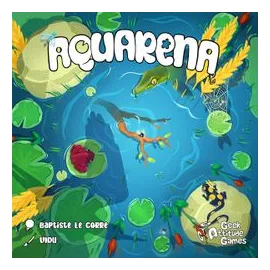
Countryside ponds are little slices of paradise where everything is calm and peaceful. Or so it seems... For pond’s people, this poetic backdrop represents a daily struggle for survival, where it’s “eat or be eaten”! Aquarena shows us what the food chain near a pond looks like. Carefully position your predators around the pond, so they can catch their favorite prey. But beware: they too can fall prey to other predators. A game takes place over 4 rounds, each of which consists of 3 successive phases: Planning, Resolution and Scoring. Planning phase: beginning with the starting player and then in clockwise order, players choose 1 card from their hand which they place on the edge of a Water tile of their choice, discard 1 other card from their hand and draw 2 new cards. Players continue taking turns until they have played 4 cards: the first 2 cards are placed face up and the last 2 cards are placed face down. Resolution phase: the starting player chooses one Water tile and reveals the face-down Predator cards that were placed on it. All cards on the tile are resolved in numerical order, from 1 to 10. When all Predator cards on the tile have been resolved, the next player in clockwise order chooses another Water tile to resolve. Continue like this until all Water tiles have been resolved. Scoring phase: players move their Frog meeple a number of spaces up the score track depending on how many flies and opponent preys they caught. The game ends after the fourth round. The player with the most victory points is the winner.