Overview
At a glance
Is this game right for my group?
ABG editorial scores on a 1–5 scale.
Harder to teach
High replayability
Highly interactive
Scales well
Deep strategy
How it plays
How does it play?
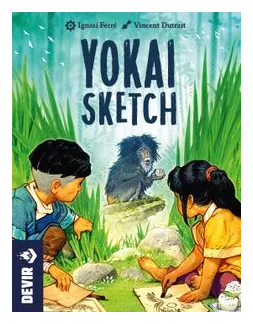
Children who go into the forest may come across some yokai, that is, supernatural creatures and phenomena. Moved by boundless curiosity, the little ones draw these spirits in their notebooks to understand their nature and learn from them.
Core mechanisms
Key systems that shape the decisions players make.
Read the full game description
Children who go into the forest may come across some yokai, that is, supernatural creatures and phenomena. Moved by boundless curiosity, the little ones draw these spirits in their notebooks to understand their nature and learn from them. With a set-collection core mechanism, the goal of Yokai Sketch is to score more yokai points than the other player by completing sketches of the elusive forest spirits. The game consists of two decks of cards: in one are four types of yokai, each associated with an element (water, fire, earth, and wind) and a numerical value that corresponds to victory points, and in the other, sketches made by humans, two of the four elements, and possibly a special ability. At the start of the game, the yokai cards are stacked in four decks (one for each element) and three sketch cards are dealt face down to players. On their turn, players draw a new sketch card and slide one of their four cards under one of the four decks in the center of the table so that it reveals the element associated with that yokai. If by doing this the yokai reaches or exceeds the number of sketches needed to draw it (adding the sketches on both sides of the card), the player who has accumulated the most sketches on their side of the table takes it. The winner's sketch cards will be placed in the discard pile, and the other player's will stay where they are as they will be used for the next yokai card of that type. If there is a tie in the number of sketches on both sides of the card, the yokai is frightened and lost. In this case, neither player manages to finish the drawing and all the sketch cards on both sides of that yokai pile are discarded. Sketch cards can also include powers: calling the yokai or distracting it to move cards. The game ends when one or more yokai decks are empty. -description from publisher