Overview
At a glance
Is this game right for my group?
ABG editorial scores on a 1–5 scale.
Harder to teach
High replayability
Highly interactive
Scales well
Deep strategy
How it plays
How does it play?
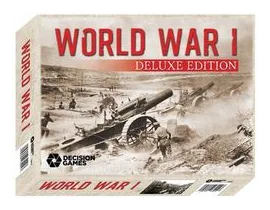
This page covers the 2018 World War I Deluxe Edition boxed game, as well as the 2015 release in Strategy and Tactics #294.
Core mechanisms
Key systems that shape the decisions players make.
Movement Points
Spend a movement allowance across spaces with different costs.
Dice Rolling
Roll dice to introduce uncertainty into actions, production, movement, or resolution.
Hexagon Grid
Use a hexagonal map where each space connects evenly in six directions.
Combat Results Table
Compare opposing strength as a ratio, then consult a table to resolve combat.
Simulation
Model a real or imagined system through detailed cause-and-effect rules.
Zone of Control
Restrict or influence movement through areas controlled by nearby pieces.
Read the full game description
This page covers the 2018 World War I Deluxe Edition boxed game, as well as the 2015 release in Strategy and Tactics #294. This game has a map that also includes North Africa and part of Asia, many more terrain types, more than twice as many counters (228 double sided counters), and a more detailed rules set than the original 1975 game that appeared in S&T #51. The earlier ones may be found here World War I: 1914-1918. World War I originated in a combustible mix of dynastic ambition, nationalism, and misplaced confidence in a short war. Europe was an armed camp with mass armies formed by conscription and national reserves. Antagonism, fear, and suspicion drove nations into a lacework of alliances. Sarajevo provided the spark that set it off, and in a matter of days the continent was at war, with empires in the balance. The map covers the entire war zone in Europe (36 miles per hex) and the Middle East (at a slightly larger scale). Terrain includes key cities, certain cultural and religious sites, primary railroads, and sea zones connecting it all. Counters represent field armies, with some specialized corps and a few markers. Six month turns keep the game playable, while multiple movement and attack phases allow for operational nuance. Mobilization Points are used to build new units, absorb combat losses, and purchase campaign markers allowing additional activity in chosen sectors. They are always in short supply, increasingly so as economies shrink over the course of the war. Neutrals, wooed by diplomacy, may bring fresh strength to bear. The main scenario covers the entire war from 1914-1918 in ten turns, while short scenarios handle the opening phase of the war (two turns) and the final great battles (four turns). Options include free setup in 1914 and an extension of the war into 1919. Victory comes from wearing down an opponent, either by capturing essential places or by exhausting mobilization points. In the game as in the war, battle is sometimes necessary for its own sak