Overview
At a glance
Is this game right for my group?
ABG editorial scores on a 1–5 scale.
Harder to teach
High replayability
Highly interactive
Scales well
Deep strategy
How it plays
How does it play?
What do the pears cost? Do I still have enough money for tomatoes?
Core mechanisms
Key systems that shape the decisions players make.
Read the full game description
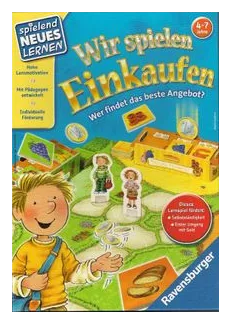
What do the pears cost? Do I still have enough money for tomatoes? The most skillful shopper goes home first with a full shopping bag. In this game children are introduced to shopping. They practice handling goods and money, learn to compare prices and take important steps towards their independence. Children must be able to count to four and compare numbers. Each player receives a shopping list showing 4 different goods and a purse with maximal 8 coins. In turns, players throw a dice yielding a number between 2 and 4, and move on ways between a common home, the bank and the four shops. The home is the starting place, the shops allow purchases and the bank allows to refill the purse. The first player to return home with all 4 goods on his shopping list purchased wins. Very simple. There are 9 different shopping goods: 3 meat products, 3 bakery products and 3 fruit/vegetable products. There are four copies of each product in the game. The butcher/bakery/greengrocery hold three copies of each meat/bakery/veggie product respectively and one copy of each product is found at the delicatessen shop. Out of its stock of 9 goods per shop, only three are on display and up for sale at a time. Goods cost between 1 and 3 coins each, depending on its display slot, clearly marked by a price tag showing coins above each good. Upon purchase, all remaining goods a shifted to the left (the cheap places) and new goods from the stock fill up the empty expensive places on the right. This may sound more complicated than it is: a three year old easily understands it and can execute the simple mechanic, thanks to arrows and price tags showing coins and not numbers. What a three year old that is yet unfamiliar with boardgames might not immediately appreciate, is the neat balancing behind the mechanic: unsold products decrease in price, whereas sought-after products increase in price; that buying bread at the delicatessen is more expensive than at the bakery, both in terms of money and distance to travel, but that the delicatessen may save travel between different shops, etc. However, learning this by playing is the hidden educational goal of the game.