Overview
At a glance
Is this game right for my group?
ABG editorial scores on a 1–5 scale.
Harder to teach
High replayability
Highly interactive
Scales well
Deep strategy
How it plays
How does it play?
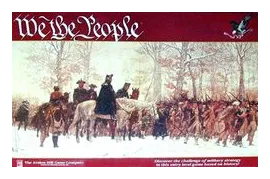
We the People was the first in what has become a very popular trend for wargaming. The typically hex-based maps were simplified into an abstract system of connected spaces, which are used for army movement and to keep track of who controls the provinces politically.
Core mechanisms
Key systems that shape the decisions players make.
Area Majority
Compete to have the strongest presence in areas that award control or points.
Dice Rolling
Roll dice to introduce uncertainty into actions, production, movement, or resolution.
Action/Event
Cards can provide player actions, trigger events, or force a choice between them.
Campaign Card Play
Play cards to command conflicts and carry consequences through a campaign.
Card Play Conflict Resolution
Resolve confrontations by choosing and comparing cards rather than only statistics.
Read the full game description
We the People was the first in what has become a very popular trend for wargaming. The typically hex-based maps were simplified into an abstract system of connected spaces, which are used for army movement and to keep track of who controls the provinces politically. The armies themselves are greatly simplified, but the general in charge of the army gains much importance through his ratings for combat effectiveness and overall strategic effectiveness. Typically, dice are used to resolve conflicts between troops, however a deck of battle cards are used instead, which captures the feel of conflict much better and gives approximately the same results seemingly without the bitterness that accompanies skewed die rolls. And lastly, the overall ebb and flow of the game is determined through the play of strategy cards, which ostensibly mark certain historical events during the Revolutionary War, but each card has multiple purposes depending on which side is attempting to use it.