Overview
At a glance
Is this game right for my group?
ABG editorial scores on a 1–5 scale.
Harder to teach
High replayability
Highly interactive
Scales well
Deep strategy
How it plays
How does it play?
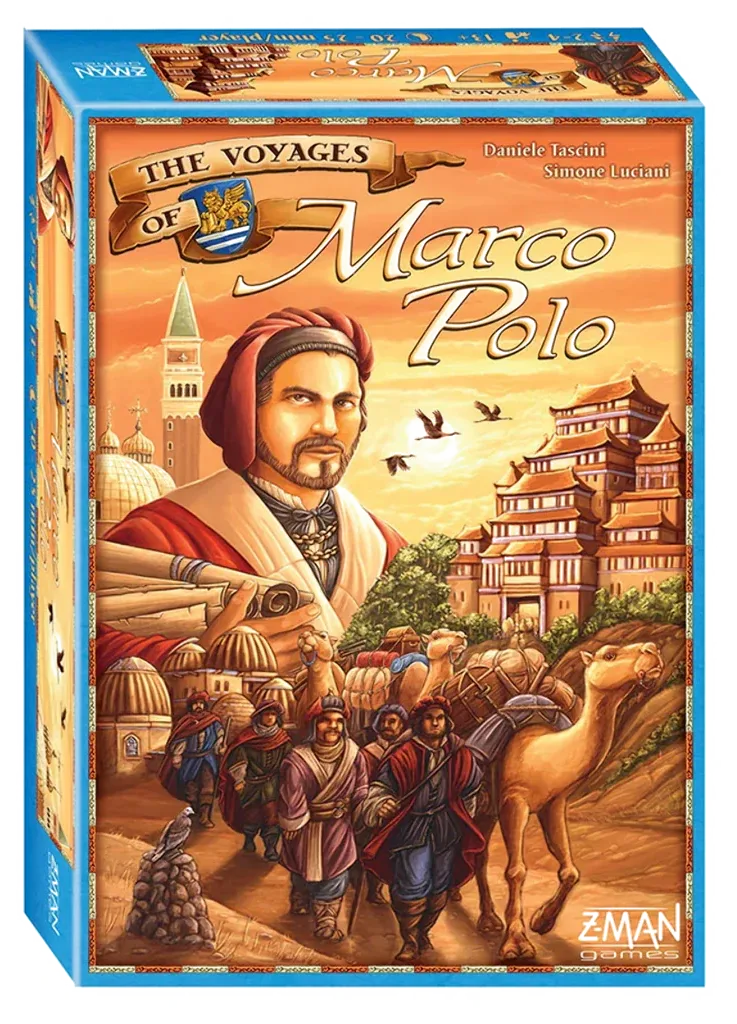
In 1271, 17-year-old Marco Polo started on a journey to China with his father and older brother. After a long and grueling journey that led through Jerusalem and Mesopotamia and over the "Silk Road", they reached the court of Kublai Khan in 1275.
Core mechanisms
Key systems that shape the decisions players make.
Contracts
Complete specific requirements to earn rewards, income, or victory points.
Dice Rolling
Roll dice to introduce uncertainty into actions, production, movement, or resolution.
Point-to-Point Movement
Move along explicit connections between named locations or nodes.
Resource to Move
Spend resources to determine or increase movement.
Turn Order: Claim Action
Determine or change the order in which players take their turns.
Read the full game description
In 1271, 17-year-old Marco Polo started on a journey to China with his father and older brother. After a long and grueling journey that led through Jerusalem and Mesopotamia and over the "Silk Road", they reached the court of Kublai Khan in 1275. In The Voyages of Marco Polo, players recreate this journey, with each player having a different character from history with a special power in the game. The game is played over five rounds. Each round, the players roll their five personal dice and can perform one action each turn with them. Each action requires the use of one or more dice, and can be collecting resources or money, acquiring contracts or traveling on the board. When traveling, each player begins at Venice and can decide between several routes eastward, all the way to Beijing. When a player stops at a city, they place a trading post there, giving them access to extra actions or resources for the rest of the game. The higher the value of the dice used for an action, the better the options that may be chosen, but also the more money the player must pay if an opponent has already chosen the same action. After five rounds, the game ends with players receiving extra victory points for having trading posts in Beijing, fulfilling the most orders, and having trading posts in the cities on secret city cards that each player gets at the start of the game. This game should not be confused with Marco Polo Expedition, which has the same German title.