Overview
At a glance
Is this game right for my group?
ABG editorial scores on a 1–5 scale.
Harder to teach
High replayability
Highly interactive
Scales well
Deep strategy
How it plays
How does it play?
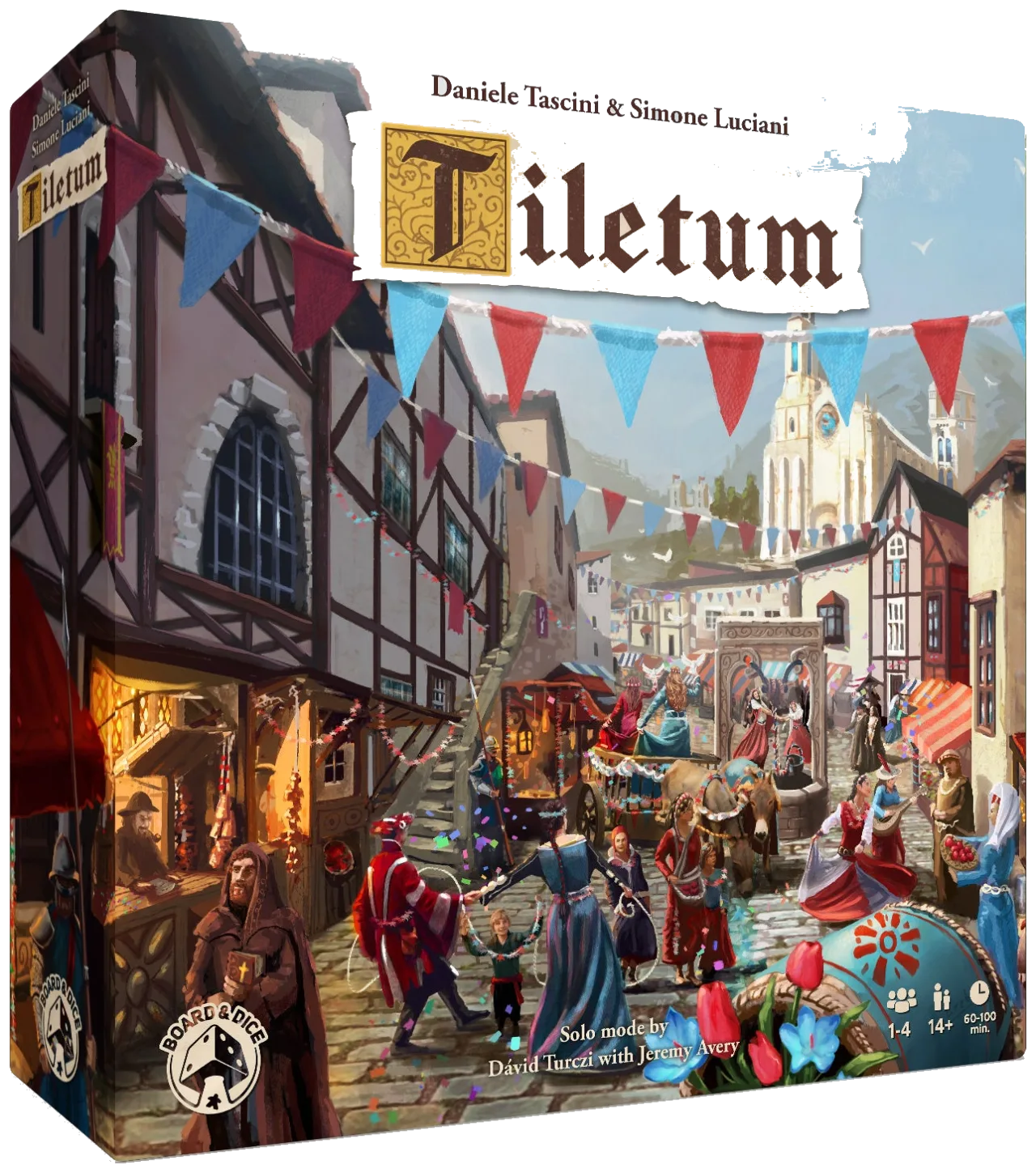
In Tiletum, you and fellow players take on the roles of rich merchants traveling throughout Europe, from Flanders to Venice, during the Golden Age of the Renaissance.
Core mechanisms
Key systems that shape the decisions players make.
Action Points
Spend a limited allowance of points across several possible actions each turn.
Contracts
Complete specific requirements to earn rewards, income, or victory points.
Dice Rolling
Roll dice to introduce uncertainty into actions, production, movement, or resolution.
Set Collection
Gather related items that become more valuable when scored together.
Point-to-Point Movement
Move along explicit connections between named locations or nodes.
End Game Bonuses
Earn additional points for meeting conditions evaluated when the game ends.
Read the full game description
In Tiletum, you and fellow players take on the roles of rich merchants traveling throughout Europe, from Flanders to Venice, during the Golden Age of the Renaissance. You will travel to various cities to acquire trade contracts for wool and iron, as well as a collection of their coats of arms. You must collect the required resources to fulfill contracts, invest in the construction of monumental cathedrals, gain the favor of noble families, and participate in important fairs where your main business occurs. You will also use the services of notable people who will be welcomed into your houses. You will thus gain prestige that will make you the most famous merchant of the Renaissance. Tiletum is a dice management game in which dice have a dual function: gaining resources and performing actions. A certain number of dice will be rolled each round. On your turn, choose a die to gain the number of corresponding resources equal to the value of the die, then perform the associated action. The power of the action is inversely proportional to the value of the die, so the fewer resources you gain, the more powerful the actions you take and vice versa.