Overview
At a glance
Is this game right for my group?
ABG editorial scores on a 1–5 scale.
Harder to teach
High replayability
Highly interactive
Scales well
Deep strategy
How it plays
How does it play?
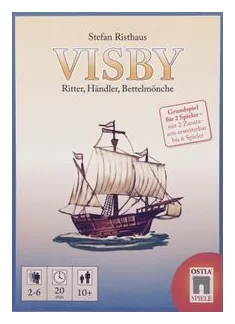
Visby is a short, but challenging game. Each player has an identical set of eight cards, each of them with a special effect.
Core mechanisms
Key systems that shape the decisions players make.
Read the full game description
Visby is a short, but challenging game. Each player has an identical set of eight cards, each of them with a special effect. At the beginning of a round, the common supply on the board becomes more attractive by adding seals (victory points) and wares and by improving the ratio to change wares into seals. All players choose one card from their hand simultaneously and place it face down in front of them (two cards in a two- or three-player game). Then the cards are revealed and the effects become active: Knights and Troops take victory points; Blacksmith gets wares for each Knight/Troops played by other players; Ships and Fleets get wares; Tollkeeper gets seals for ships and fleets; Merchant changes wares into seals; Monk gets wares for merchants and number of cards already played. Players with a monk take all cards back to their hand, while others proceed with their remaining cards. The specific issue is that the more efficient cards become effective only after those which are not that strong. For example, a fleet gets you three wares, but the ship gets you all the remaining ones. If there are ten wares and one opponent played a fleet, you get the seven remaining wares after he has taken three. If three other players play a fleet and take three wares each, you gain only one for your ship. How effective your card is depends on what the other players do — but you cannot be sure of what they'll do because all decisions are made simultaneously. Perhaps, though, you remember which cards the others have already played... Visby comes in a basic set for two players and can be enlarged with one or two expansion packs that contain material for two additional players each (to the maximum of six players).