Overview
At a glance
Is this game right for my group?
ABG editorial scores on a 1–5 scale.
Harder to teach
High replayability
Highly interactive
Scales well
Deep strategy
How it plays
How does it play?
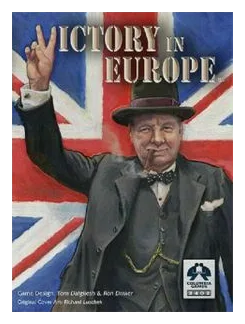
Victory in Europe is a game covering the Second World War in Europe from 1939 to 1945. One player commands the Axis powers, the other the Allies.
Core mechanisms
Key systems that shape the decisions players make.
Area Movement
Move pieces between connected regions rather than along individual spaces.
Campaign Card Play
Play cards to command conflicts and carry consequences through a campaign.
Dice Rolling
Roll dice to introduce uncertainty into actions, production, movement, or resolution.
Secret Unit Deployment
Place or assign units secretly before their positions are revealed.
Simulation
Model a real or imagined system through detailed cause-and-effect rules.
Events
Triggered events alter the shared state, rules, or available choices.
Read the full game description
Victory in Europe is a game covering the Second World War in Europe from 1939 to 1945. One player commands the Axis powers, the other the Allies. Players maneuver their armies on an area map of Europe, fighting for control of key victory cities and critical resources. Air, naval, and ground units are all involved. Battles are fought when enemy units clash in the same area. The early war 1939-1941 is driven by the Axis, but gradually the Allies become stronger and usually take the initiative by 1943. However, the game need not unfold exactly like history. The French may survive 1940, the Germans may invade Britain. Germany may attack Russia in June 1941, or attack earlier, or later, or not at all. The Soviets may attack Germany first which was likely their plan. The USA might enter the war in 1942, perhaps earlier, perhaps later. All of these decisions are made by the players, influenced by Diplomatic events that are controlled by game events. Invading neutral countries such as Norway or Belgium has consequences.