Overview
At a glance
Is this game right for my group?
ABG editorial scores on a 1–5 scale.
Harder to teach
High replayability
Highly interactive
Scales well
Deep strategy
How it plays
How does it play?
In the early 1900s, the Austrian neurologist Sigmund Freud established a revolutionary theory called psychoanalysis, related to the study of the unconscious mind.
Core mechanisms
Key systems that shape the decisions players make.
Contracts
Complete specific requirements to earn rewards, income, or victory points.
Open Drafting
Select cards or items from a shared face-up display.
Programmed Movement
Plan movement commands in advance before revealing and resolving them.
End Game Bonuses
Earn additional points for meeting conditions evaluated when the game ends.
Melding and Splaying
Combine cards into sets and spread them to expose additional icons or effects.
Read the full game description
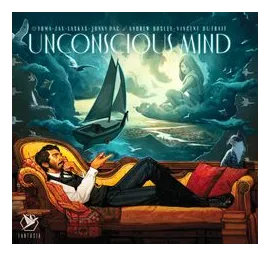
In the early 1900s, the Austrian neurologist Sigmund Freud established a revolutionary theory called psychoanalysis, related to the study of the unconscious mind. As his work took hold, a number of followers were invited to meet at Freud's apartment every Wednesday afternoon to discuss various ideas about psychology and the meanings of dreams. This group was called the Wednesday Psychological Society. It marked the beginning of the worldwide psychoanalytic movement. As a member of this society in Unconscious Mind—a game that blends worker placement, engine building, action programming, and multiple rondels—your goal is to master therapeutic techniques, establish a practice, and grow your clientele. By delving into your clients' dreams—their unconscious minds—you can help them reach catharsis and recover from their traumas and layers of grief. As a result, the people you treat will be able to live happier, more productive lives. Alongside that, you can document your discoveries by publishing treatises—which may later be cited by other researchers—to advance your scholarly reputation. In more detailed gameplay terms: on your turn, you may place speech-bubble-shaped "ideas" to access different action spaces on the meeting table board. Then, depending on which row you chose, you will advance the inkpot on your player board's rondel a number of steps—triggering the effects of all the technique tiles in the given line. Besides the meeting table, there is a second board showing central Vienna. You may visit key historic locations on it with your professor meeple—sometimes meeting up with Freud himself to gain bonus actions (or a potent cup of coffee). Once you have gathered enough insights (the main resources in the game), you may use them to interpret your clients' dreams. As you work your way from surface-level "manifest" dreams down to deeper "latent" dreams, you can help your clients dispel their grief layers (represented by lifting off transparent cards) and eventually resolve their issues altogether—unlocking ongoing rule-bending abilities and end-game scoring opportunities. The game has many interconnected systems that flow into each other, making every turn one that results in cascading, chain effects. —description from the publisher