Overview
At a glance
Is this game right for my group?
ABG editorial scores on a 1–5 scale.
Harder to teach
High replayability
Highly interactive
Scales well
Deep strategy
How it plays
How does it play?
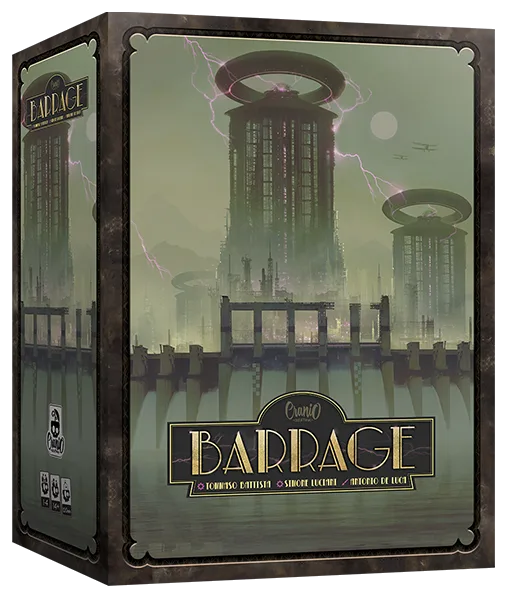
In the dystopic 1930s, the industrial revolution pushed the exploitation of fossil-based resources to the limit, and now the only thing powerful enough to quench the thirst for power of the massive machines and of the unstoppable engineering progress is the unlimited hydroelectric energy provided by the rivers. Barrage is a resource management strategic game in which players compete to build their majestic dams, raise them to increase their storing capacity, and deliver all the potential power through pressure tunnels connected to the energy turbines of their powerhouses.
Core mechanisms
Key systems that shape the decisions players make.
Action Retrieval
Previously used actions must be recovered before they can be selected again.
Contracts
Complete specific requirements to earn rewards, income, or victory points.
Network and Route Building
Create connected routes that improve reach, delivery, control, or scoring.
Income
Receive recurring resources according to your position, assets, or development.
End Game Bonuses
Earn additional points for meeting conditions evaluated when the game ends.
Read the full game description
In the dystopic 1930s, the industrial revolution pushed the exploitation of fossil-based resources to the limit, and now the only thing powerful enough to quench the thirst for power of the massive machines and of the unstoppable engineering progress is the unlimited hydroelectric energy provided by the rivers. Barrage is a resource management strategic game in which players compete to build their majestic dams, raise them to increase their storing capacity, and deliver all the potential power through pressure tunnels connected to the energy turbines of their powerhouses. Each player represents one of the four international companies who are gathering machinery, innovative patents and brilliant engineers to claim the best locations to collect and exploit the water of a contested Alpine region crossed by rivers. Barrage includes two innovative and challenging mechanisms. First, the players must carefully plan their actions and handle their machinery, since both their action tokens and resources are stored on a Construction Wheel and will only be available after a full turn of the wheel. The better you manage your wheel, the earlier your resources and actions come back to you. Second, the water flow on the rivers depicted on the board is a shared and contested resource. Players have to intercept and store as much of the water as they can, build dams (upstream dams are expensive but can block part of the water before it reaches the downstream dams), raise the dams to increase their capacity, and build long tunnels to channel the water to their powerhouses. Water is never consumed — its flow is just used to produce energy —, it is instead released back to the rivers, so you have to strategically place your dams to recover the water diverted by you and the other players. Over five rounds, the players must fulfill power requirements represented by a common competitive power track and meet specific requests of personal contracts. At the same time, by placing a limited number of engineers, they attempt to enhance their machinery to acquire new and more efficient construction actions and to build and activate special unique-effect buildings to forward their own developing strategy.