Overview
At a glance
Is this game right for my group?
ABG editorial scores on a 1–5 scale.
Harder to teach
High replayability
Highly interactive
Scales well
Deep strategy
How it plays
How does it play?
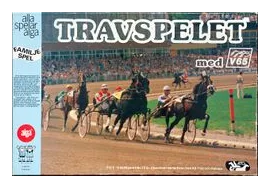
This harness racing game is one of a number of Alga games that deals with horses and horse racing. See also Jägersro and Månvalla med V5.
Core mechanisms
Key systems that shape the decisions players make.
Auction/Bidding
Bid against other players to determine who receives an item, action, or priority.
Betting and Bluffing
Risk resources on uncertain outcomes while disguising intentions or information.
Dice Rolling
Roll dice to introduce uncertainty into actions, production, movement, or resolution.
Roll-and-Move
Roll dice or spin a dial to determine how far a piece moves.
Variable Phase Order
The order of phases changes according to player choices or game state.
Read the full game description
This harness racing game is one of a number of Alga games that deals with horses and horse racing. See also Jägersro and Månvalla med V5. A full game consists of six starts divided into three phases (2 starts each). Before each phase, horses are auctioned off to the players; each player gets 2, 4 or 6 horses depending on the number of players. After each phase, players can keep only one horse from the preceding phases, the rest are auctioned off again. Auction is followed by training which is played on a short "training track" on the game board; here the horses can get better - each horse has a value from -5 to +5 which will help/hinder in the roll-and-move race - and the players may also get cards for later use during the actual race. Results of the training define starting positions for the race and also give some clue as to each horse's capabilities, so now it's time for betting. A player can bet on up to 2-3 horses, depending on the number of players; betting is secret, and a player can freely bet on any horses, including their opponents'. The actual race is conducted as roll-and-move using 2 dice. A special die is used for moving the horses, adding or subtracting their individual modifiers, and a regular d6 is used to determine if a player must pick a race card (on 1 or 6). These affect the race directly and often quite drastically; some may be saved for later use. After the race the winning horse gets it's modifier increased by one step, all bets are revealed, money paid out from the bank and preparations made for the next race. Horses that competed in a race may not compete in the immediate next one - this is why the players have several. After the 2nd and 4th races, the auction phase is repeated. At the end of the game, a bonus is paid to players who managed to bet on the winning horse in 5 or 6 races, any bank loans are paid back, and winner is the player with most money. Approximate play sequence: 1) Auction - buy a number of horses 2) Train them for the race 3) Select horses for race 1 4) Betting phase 5) Run short race 6) Pay winner, both race and betting money. 7) Repeat 3-6, but with long race 8) repeat 1-6 twice 9) Pay bonus to anyone who has picked the winner in at least 5 of the 6 races.