Overview
At a glance
Is this game right for my group?
ABG editorial scores on a 1–5 scale.
Harder to teach
High replayability
Low interaction
Scales well
Deep strategy
How it plays
How does it play?
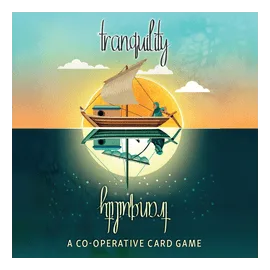
Jump on board the good ship Tranquility and set sail for paradise. Take care, though, because in a land where the day blends into night it's easy to lose track of time and you still need to find that special little island to call home.
Core mechanisms
Key systems that shape the decisions players make.
Communication Limits
Rules restrict what players may say, show, or reveal while cooperating.
Cooperative Game
Players coordinate their actions toward a shared objective and win or lose together.
Hand Management
Time and sequence a limited hand of cards to preserve future options.
Tile Placement
Place tiles to build a shared or personal spatial arrangement.
Solo / Solitaire Game
Provide rules and objectives designed for a single player.
Read the full game description
Jump on board the good ship Tranquility and set sail for paradise. Take care, though, because in a land where the day blends into night it's easy to lose track of time and you still need to find that special little island to call home. Tranquility is a co-operative card game in which players must fill the sea with islands — specifically island cards with numbers on them — and guide the ship home before any player runs out of cards. Note that in the world of Tranquility, the only way to play is in silence. --- The goal of the game is for the team to complete the grid before any player runs out of available actions. Cards must be placed so that the grid ascends in numerical order from bottom left to top right. All the players win if they manage to complete the grid and have placed a Start and Finish card. All players lose if a single player can no longer play or discard any cards legally following the instructions given below. The players may not, however, communicate. Play is taken in turns moving clockwise with the quietest player going first. On a player’s turn they must do one of the following: 1. Play a card or 2. Discard two cards. Then they must draw back up to a hand of five cards. Cards must be placed so that the grid ascends in numerical order from bottom left to top right. If the card is placed next to an existing card in the sequence then they must discard cards from their hand equal to the difference between the numbers face down in front of them e.g. placing a 5 next to a 3 will require two cards to be discarded from their hand. This applies even if the cards are on different rows. —description from the publisher