Overview
At a glance
Is this game right for my group?
ABG editorial scores on a 1–5 scale.
Harder to teach
High replayability
Highly interactive
Scales well
Deep strategy
How it plays
How does it play?
Trying to invest in the future? Read the stock reports, follow the trends, talk to valued advisors.
Core mechanisms
Key systems that shape the decisions players make.
Read the full game description
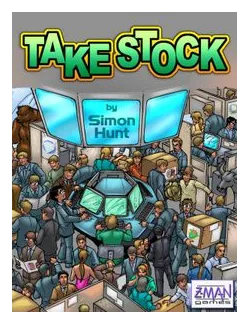
Trying to invest in the future? Read the stock reports, follow the trends, talk to valued advisors. Or chuck the whole thing and play Take Stock ! You are the power players. You can choose to make the prices rise as you purchase stocks in strong companies, or you can choose to crush the dreams of your opponents by freezing their accounts or crashing the market. Remember, the one with the most at the end wins! Each player collects stock certificates in five stocks, (Crispyflake Corn Cereal Co., Glittering Gems Ltd., Zeta-Chip Technology Ltd., Arctic Oil Drilling Co., and Movie Madness Distributors), that they hope will have a high price when the market closes. The goal of the game is to accumulate the highest score after four rounds of play. Contents: 100 Cards 30 Tokens 1 Rulebook There are 60 "share" cards (numbered 1-12 for each stock) representing a stock value if placed in the market, or representing a certificate of 1, 2 or 3 shares if placed in front of the player. There are 40 "market event" cards which affect the stock market in various ways: 3 stock splits, 1 stock crash and 1 insider trading for each stock; 4 stock audits; 3 stock freezes; 2 no market changes; 1 market upturn; 1 market downturn; 1 stock option gained; 1 stock option lost; 1 market crash; and 1 market closed. There are 30 tokens representing stock options allocated to the players at the beginning of the game. The stock starter cards (the 1's) are placed in a column in the middle of the table to represent the stock market. The value of each stock is represented by the highest number in each row. During each round, players may choose to increase the value of a particular stock by playing a card from their hand onto the corresponding row on the table. Players may also choose to place cards from their hand onto the table in front of them, to represent shares acquired for a particular stock. Market events may also be played to affect the market prices. At the end of each round, options may be exercised to buy up extra shares, after the market has closed. Each player's score is calculated by multiplying the closing price of each stock with the number of shares held for that stock. The winner is the player with the highest score at the end of four rounds.