Overview
At a glance
Is this game right for my group?
ABG editorial scores on a 1–5 scale.
Harder to teach
High replayability
Highly interactive
Scales well
Deep strategy
How it plays
How does it play?
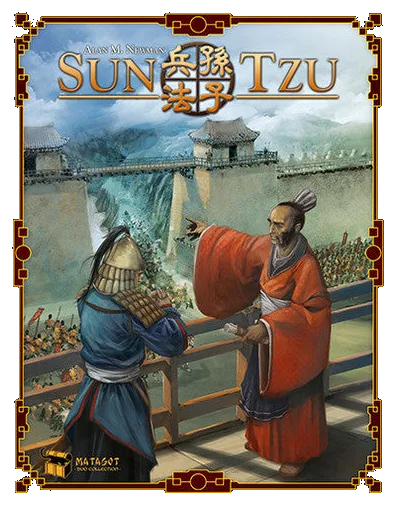
In 506 BC, Sun Tzu marched up the Hwai River where he was assaulted by Ch'u armies under the command of King Shao. Sun Tzu and his Wu soldiers were outnumbered and King Shao's armies held the high ground.
Core mechanisms
Key systems that shape the decisions players make.
Area Majority
Compete to have the strongest presence in areas that award control or points.
Area Movement
Move pieces between connected regions rather than along individual spaces.
Simultaneous Action Selection
Choose actions secretly or concurrently before revealing them together.
Card Play Conflict Resolution
Resolve confrontations by choosing and comparing cards rather than only statistics.
Force Commitment
Commit resources or units before all relevant information is known.
Read the full game description
In 506 BC, Sun Tzu marched up the Hwai River where he was assaulted by Ch'u armies under the command of King Shao. Sun Tzu and his Wu soldiers were outnumbered and King Shao's armies held the high ground. Sun Tzu feigned retreat and tricked King Shao into spreading out his forces, ready to pursue. With the Ch'u scattered, Sun Tzu crushed their forces in piecemeal fashion at the battle of Bai Ju, routing the Ch'u back to their capital of Ying. King Shao fled Ying seeking refuge and asylum across the borders while Sun Tzu remained the master of strategy and tactics. In Sun Tzu, a.k.a. Dynasties, players take on the role of Sun Tzu or King Shao, leading these two opposing armies in an attempt to unify China through the deployment of their armies and forces rather than by brute force. Each turn players play cards to specific provinces, then reveal them individually by province. Armies are added or removed from the province depending on who played the higher valued card or who played a special card. Some cards can only be used once, so playing the card at the correct time is critical to a winning strategy. The game has a feel of "tug-of-war" as the scoring marker starts in the middle of the scoring scale and the players attempt to move the marker to their side of the track. The game ends after nine rounds or if either player is able to move the scoring marker to the last space on his side of the scoring track.