Overview
At a glance
Is this game right for my group?
ABG editorial scores on a 1–5 scale.
Harder to teach
High replayability
Highly interactive
Scales well
Deep strategy
How it plays
How does it play?
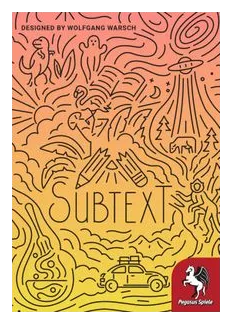
In Subtext, players try to communicate with one another by drawing hints about the word on their card. Drawing well is not required — just being clever in selecting your hints.
Core mechanisms
Key systems that shape the decisions players make.
Hidden Roles
Players conceal team, loyalty, or identity information from one another.
Paper-and-Pencil
Record choices and results directly on a personal sheet.
Voting
Players collectively approve, reject, or select an outcome through votes.
Targeted Clues
Give clues intended for a particular player, word, or hidden target.
Read the full game description
In Subtext, players try to communicate with one another by drawing hints about the word on their card. Drawing well is not required — just being clever in selecting your hints. Each round, one person is the dealer. This player looks at their word, then shuffles the card into the cards for the other players and distributes them randomly. By doing this, one player will have the same word as the dealer, but nobody — not even the dealer — knows who it is. The dealer then draws a picture, and you want to hint at your word so that ideally only the person who has the same word will understand what you're depicting. In the subsequent guessing phase, all players (including the dealer) guess which player got the same word as the dealer. Points are awarded based on the number of incorrect guesses, but the dealer and their partner have to guess correctly to even get points. How vague do you want to be in your drawing efforts to still get your message across without anyone else knowing it?