Overview
At a glance
Is this game right for my group?
ABG editorial scores on a 1–5 scale.
Harder to teach
High replayability
Highly interactive
Scales well
Deep strategy
How it plays
How does it play?
Despite earlier attempts, Martin Luther started the Reformation in 1517 with his "Ninety-Five Theses". Luther criticized the selling of indulgences and stated that the Catholic doctrine of the merits of the saints had no foundation in the gospel.
Core mechanisms
Key systems that shape the decisions players make.
Read the full game description
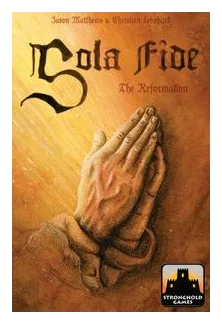
Despite earlier attempts, Martin Luther started the Reformation in 1517 with his "Ninety-Five Theses". Luther criticized the selling of indulgences and stated that the Catholic doctrine of the merits of the saints had no foundation in the gospel. The "Protestants" soon incorporated doctrinal changes such as Sola Scriptura (Scripture alone) and Sola Fide (faith alone). These changes turned out to be not only theological, but also influential in the Reformation in other ways: the rise of nationalism, the Western Schism that eroded people's faith in the Papacy, the perceived corruption of the Roman Curia, the impact of humanism, and the new learning of the Renaissance that questioned much of traditional thought. The Roman Catholic church responded with a counter-reformation initiated by the Council of Trent. In the two-player game Sola Fide: The Reformation, by the renowned design team of Jason Mathews and Christian Leonhard, players attempt to install Reformation in the Holy Roman Empire or try to prevent it, battling the Holy Roman Empire's Imperial Circles.