Overview
At a glance
Is this game right for my group?
ABG editorial scores on a 1–5 scale.
Harder to teach
High replayability
Highly interactive
Scales well
Deep strategy
How it plays
How does it play?
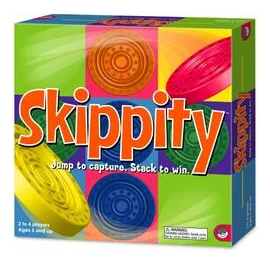
If Susan McKinley Ross' Qwirkle can be described as a simplified Scrabble – with colors and shapes replacing letters – then her 2010 release from MindWare – Skippity – might be dubbed "checkers for the Timothy Leary set".
Core mechanisms
Key systems that shape the decisions players make.
Read the full game description
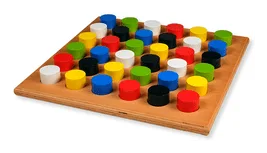
If Susan McKinley Ross' Qwirkle can be described as a simplified Scrabble – with colors and shapes replacing letters – then her 2010 release from MindWare – Skippity – might be dubbed "checkers for the Timothy Leary set". On a blazingly colored 10x10 game board, players randomly lay out one hundred tokens in five colors, then remove the tokens from the four central squares. On a turn, a player takes a single token and jumps orthogonally over an adjacent token to an empty space, capturing the token jumped. Multiple jumps are possible, with the player capturing each token jumped. The game ends when no more jumps are possible. Players then compare their stacks of tokens, with each set of five differently-colored tokens counting as a set. The player with the most sets wins, with the tiebreaker being the number of tokens captured but not in sets.