Overview
At a glance
Is this game right for my group?
ABG editorial scores on a 1–5 scale.
Harder to teach
High replayability
Highly interactive
Scales well
Deep strategy
How it plays
How does it play?
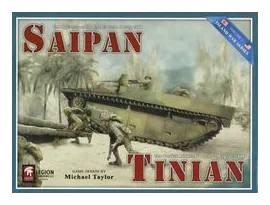
Saipan & Tinian, Island War Series - Volume I by Michael Taylor Saipan is a simulation of the American invasion and capture of Saipan in the summer of 1944.
Core mechanisms
Key systems that shape the decisions players make.
Read the full game description
Saipan & Tinian, Island War Series - Volume I by Michael Taylor Saipan is a simulation of the American invasion and capture of Saipan in the summer of 1944. Part of Admiral Nimitz's Operation Granite II, the seizure of the Marianas was divided into two parts, the Northern Troops Landing Force (NTLF) and the Southern Troops Landing Force (STLF). Saipan and Tinian were the objectives for the NTLF, with Saipan being the immediate objective and Tinian the second. The STLF objective was Guam. Before the Capture of Saipan both the US Navy and the Japanese Navy had powerful carrier based air forces, and with the exception of China based aircraft, no US land based aircraft could reach homeland Japan. After the capture of Saipan only the US Navy had a powerful carrier based air arm, and powerful land based bombers could now bomb Japan relentlessly. Tinian is a simulation of the American invasion and capture of Tinian in the summer of 1944. Tinian was the first US Marine Corps sized shore-to-shore operation and it was the first time napalm was used against enemy troops. After its seizure Tinian was developed into the greatest B-29 base in the war. B-29s from Tinian flew 29,000 missions and dropped over 157,000 tons of bombs on Japan by the end of the war, including the two atomic bomb missions flown by the "Enola Gay" and "Bocks Car" against Hiroshima and Nagasaki. Saipan Game Components: 17" x 22" map 270 Double-sided game counters Tinian Game Components: 11" x 17" map 180 Double-sided counters Game scale: Unit size: Platoon, Company, and Battalion Scale: Hex scale: 1/2 mile Game Turn: Each turn represents 12 hours The Island War Series game system is a simulation of ground combat in the Pacific during World War II. Each game in the system represents a battle between Allied and Imperial Japanese forces on one of the many Pacific Islands. The series begins with Vol. I - Saipan/Tinian and will also include Guam - Vol. II , and Attu & Kiska - Vol. III. Two sets of rules are provided with each game. The first contains the Standard Rules that are common to all the games in the Pacific Island Series. The second set contains the Exclusive Rules for each game in the system, which includes Special rules, the Initial Deployment and the Reinforcement Schedule. Generally the unit scale is battalion, but there are company and platoon formations represented. The time scale, unless noted in the Exclusive rules, is 1/2 day per turn. Due to the nature of the battles covered in the series, all naval and air forces are abstract. This means the main focus of each game is ground combat. The games are designed for two players, but can accommodate multiple players. For example, one player can play the US Marines, one can play the US Army, and the third plays the Japanese. This series of games is loosely based on or inspired by several different game systems, including SPI's Island War series and GRD/GDW's Europa series, but many concepts are quite original. The tactical situation for the defender can be described as "against the odds", which means it will be very difficult for the player playing the defender to win the game tactically. The victory conditions are designed in such a way that the defender can win by performing better than his historical counterpart. This also puts a lot of pressure on the attacker because he cannot afford to make many mistakes. Game features include: 1. Limited intelligence 2. Amphibious Landings 3. Night rules 4. Banzai attacks 5. Coastal Defense units 6. Beachheads and Replacements 7. Fortifications 8. Weather