Overview
At a glance
Is this game right for my group?
ABG editorial scores on a 1–5 scale.
Harder to teach
High replayability
Highly interactive
Scales well
Deep strategy
How it plays
How does it play?
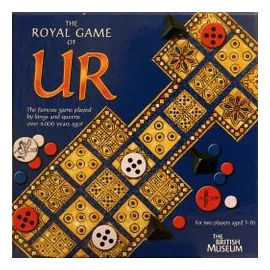
The game has been published under different names but it is a simple race game very much like Backgammon. This edition has a board that is a reproduction of the original found in the Mesopotamian city of Ur.
Core mechanisms
Key systems that shape the decisions players make.
Race
Compete to reach a destination, threshold, or objective before opponents.
Roll-and-Move
Roll dice or spin a dial to determine how far a piece moves.
Static Capture
Capture opposing pieces through fixed positional relationships.
Square Grid
Use an orthogonal grid where position and adjacent spaces shape movement or placement.
Read the full game description
The game has been published under different names but it is a simple race game very much like Backgammon. This edition has a board that is a reproduction of the original found in the Mesopotamian city of Ur. Each player brings their 7 pieces in to play and takes them off of their outer track. Opposing pieces come into conflict on the inner track that they must travel on to the exit. If you land on a space occupied by a single opponent's piece you send it back to the start. If you land on a space occupied by 2 or more opponent's pieces then your piece goes back to the start. The four dice give a marked or blank result. They are tetrahedral (four-sided) dice. Each die gives a "1" or a "0". You can roll 0,1,2,3, or 4. Statistically, 2 is most common- a good thing to bear in mind. The rosette in the central track is a "safe" place from which you cannot be bumped, but you can be bumped on others. Landing on any rosette allows you to roll again, but you don't need to move that same piece. All moves must be made by one piece only. First to bear off all 7 of his pieces wins. Note - Rules update in line with guidance from Irving Finkel from British Museum. The game may be a relative of Senet and Aseb.