Overview
At a glance
Is this game right for my group?
ABG editorial scores on a 1–5 scale.
Harder to teach
High replayability
Highly interactive
Scales well
Deep strategy
How it plays
How does it play?
Linked game discovered from BGG. Full scrape pending.
Core mechanisms
Key systems that shape the decisions players make.
Action Queue
Place actions into an ordered queue that resolves now or on later turns.
Grid Movement
Move pieces between adjacent spaces on a regular grid.
Programmed Movement
Plan movement commands in advance before revealing and resolving them.
Bias
Hidden or asymmetric information systematically changes how outcomes are interpreted.
Modular Board
Build the play area from interchangeable sections that vary between games.
Read the full game description
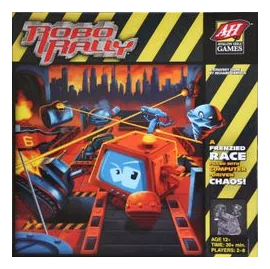
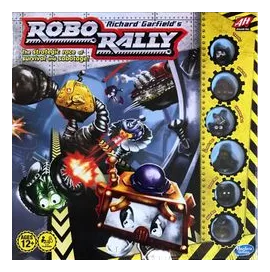
The race is on for the robots of the Robo Rally automobile factory who work long, hard days at the assembly line building high?speed supercars, but never get to see them in action. On Saturday nights, the factory comes to life as the ultimate race course with treacherous obstacles and rival sabotage. In Robo Rally, players move their robots through the course by speeding through corridors and dodging traps to reach each checkpoint first. Only the strongest robots survive! Enter the world of mad machines and dangerous schemes in the Robo Rally board game. Players control their robot with game cards which reveal directions on how the robots can move through the hectic Robo Rally automobile factory. Use strategy to outsmart rival robots while racing towards each checkpoint in your chosen course in numerical order. Beware of factory obstacles such as industrial lasers, gaping pits, and moving conveyer belts that can make or break the race. The 2016 edition of Robo Rally differs from earlier versions in a number of ways: Players each now have their own deck of twenty cards, with the same cards in each deck. On a turn, a player draws nine cards from their deck, programs five of the cards, then discards the rest. Two cards says "Again" and repeat the action programmed in the previous slot; one card says "Energy" and gives a energy cube which you can use to buy options. Since each player has their own deck, the cards no longer have priority numbers to determine who moves first. Now movement order is determined by whoever is closest to a transmitter on the game board. When players are damaged, they no longer receive one less card for each damage (or have one of their program registers locked) at the start of a round; instead they receive damage cards that will be shuffled into their decks. "Normal" damage from the board or a robot laser gives you "spam" damage. When you program one of these cards, you remove it from play at the appropriate time and replace it in the register with the top card from your deck. Surprise! Other types of damage exist, with a Trojan horse granting you two spam, a virus infecting nearby players, and a worm forcing you to reboot, which gives you even more damage. By playing the damage, though, you remove it from your deck.