Overview
At a glance
Is this game right for my group?
ABG editorial scores on a 1–5 scale.
Harder to teach
High replayability
Highly interactive
Scales well
Deep strategy
How it plays
How does it play?
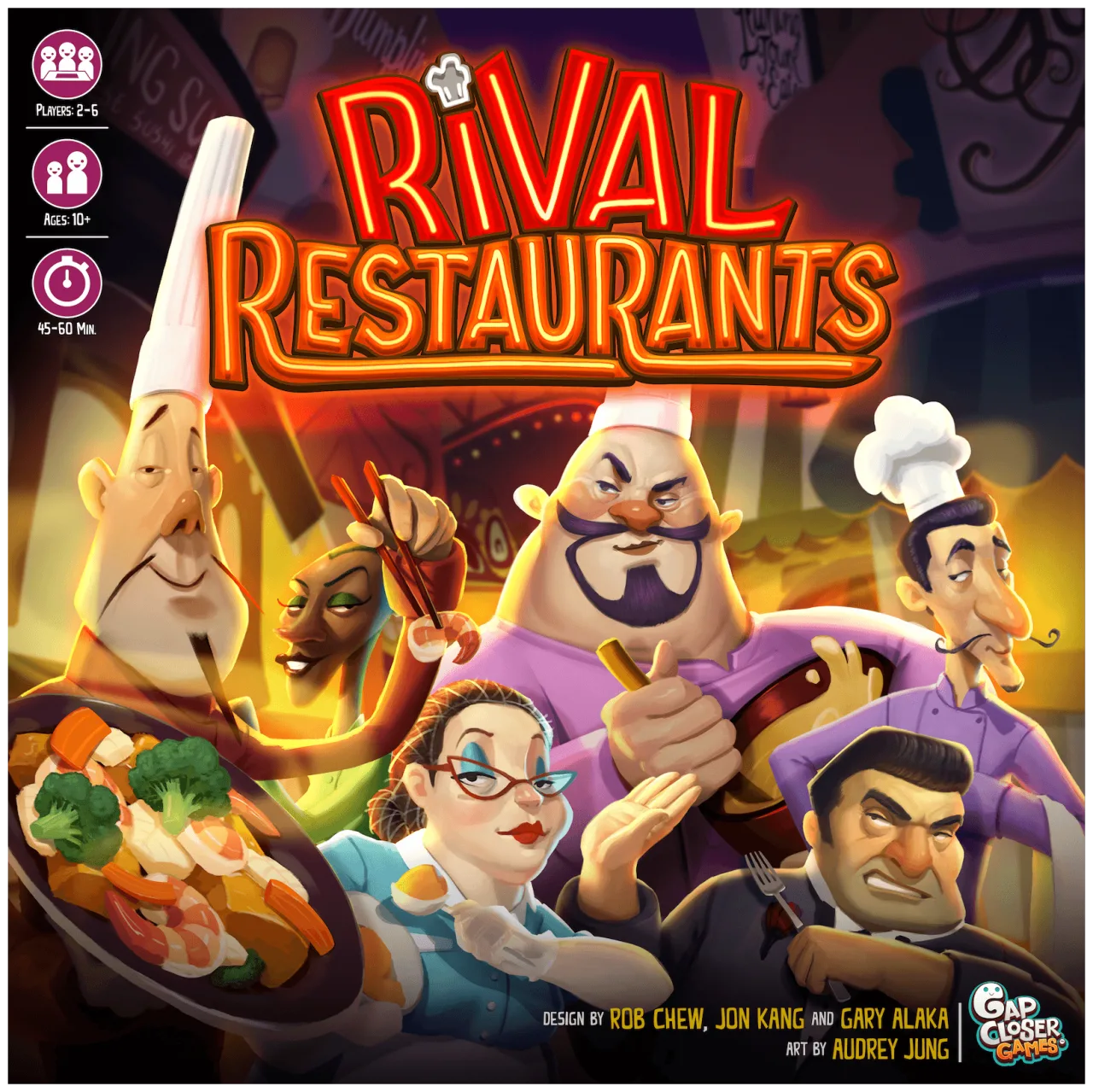
Your goal in Rival Restaurants is to be the first restaurant to get 20 popularity points and be crowned "The Wiener!" Players earn popularity points by buying and trading for ingredients and using them to "cook" (complete) recipes.
Core mechanisms
Key systems that shape the decisions players make.
Auction/Bidding
Bid against other players to determine who receives an item, action, or priority.
Contracts
Complete specific requirements to earn rewards, income, or victory points.
Negotiation
Make proposals, promises, or deals directly with other players.
Set Collection
Gather related items that become more valuable when scored together.
Real-Time
Players act under continuous time pressure rather than taking normal turns.
Read the full game description
Your goal in Rival Restaurants is to be the first restaurant to get 20 popularity points and be crowned "The Wiener!" Players earn popularity points by buying and trading for ingredients and using them to "cook" (complete) recipes. The more advanced the recipe, the more points it's worth. Each day, players move through three phases: 1. MONEY and MOVE: Players collect their income for the day and decide where they want to move. Turn economy is crucial as players are not permitted to move for the rest of the day once their location has been chosen. 2) BUY and BARTER: Players have one minute to buy as much as they want but only from the location they're in. Players can also barter/trade with anyone in the game, not just the people in their location. 3) COOK and COUNTER. Any player who has all the ingredients required for their recipe can cook it and collect popularity points. In addition, each player controls a chef equipped with their own "chef power". Chef powers are asymmetrical and allow players to bend the rules in their favor. The base game of Rival Restaurants has twelve chefs, and additionally, at the beginning of the game, each player must choose a restaurant to play, with each restaurant having a unique level-up structure with rewards for reaching 3, 7, and 12 popularity points. Lastly, players can also choose to buy "action cards", that is, development cards that are typically for one-time use.