Overview
At a glance
Is this game right for my group?
ABG editorial scores on a 1–5 scale.
Harder to teach
High replayability
Highly interactive
Scales well
Deep strategy
How it plays
How does it play?
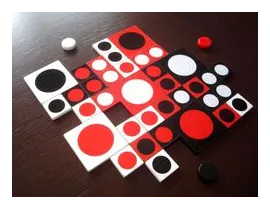
RED is a game from the RED, BLUE, GreenGreenerGreenest trilogy. RED is a three-colored tile-laying game for three players.
Core mechanisms
Key systems that shape the decisions players make.
Read the full game description
RED is a game from the RED, BLUE, GreenGreenerGreenest trilogy. RED is a three-colored tile-laying game for three players. The three colors in the game are black, white, and red, and each player will be a different color. Each tile has a background color and a different-colored circle in the middle. There are 6 different combinations and 5 small tiles and 1 large tile for each combination. Players place tiles on the table trying to connect groups of their border color and groups of their circle color. RULES Place all the tiles face-up in a pool, leaving room to play the game. Each player is assigned one of the three colors by some agreeable method and takes the corresponding counter; the counters just show which player is which color. The order of play is White player, then Black, then Red. Players take turns placing any tile from the pool on the playing surface according to the following rules: - Tiles must be placed so that they align with an imaginary grid of squares the size of the small tiles. - White cannot play a large tile on the first turn. - Except for the obvious exception of the first tile, each new tile must be orthogonally adjacent to at least one small tile (i.e. must touch a small tile). Just having the corners touch isn't good enough. - A large tile cannot be placed orthogonally adjacent to another large tile (that is, no two large tiles can touch each other, except at the corners). The game ends when there are no available moves. SCORING Small tiles count as 1 point, and large tiles count as 2 points. Find the largest connected group of tiles with your border color, and then find the largest connected group of tiles with your circle color. Multiply these two numbers to determine your score. The player with the most points wins. If two players tie, the third player wins! If all three tie, play again! The rules include a variant for 2 players. Microbadges: