ABG All Board Games
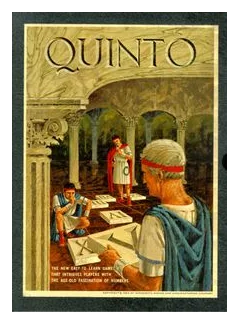
Quinto box art

Quinto

Players

2-4

Time

?-?

Age

8+

Weight

1.83

Rating

6.08

Fit

Teach 2.4

Teaching signal

Replay 4.0

High replayability

Interaction 3.7

Highly interactive

Scaling 4.0

Scales well

Strategy 4.5

Deep strategy

Control 3.0

Luck-sensitive

Table feel

Quinto has a high level of direct confrontation and strategic depth in confrontation. Players need to frequently pay attention to and react to each other's strategies and turns. While there is not a strong emphasis on cooperation, the game still offers a good level of player interaction overall.

Replay value

Quinto has a high replayability score due to its high variability gameboard, expansions available, strategic depth, scalability, and moderate easiness to learn. The game offers different experiences each time it is played, with the potential for new tactics and strategies to be discovered. The presence of expansions adds new content and gameplay elements, further enhancing the replay value. The game adapts well to different player counts without compromising its appeal or balance. While it may take some time to learn, it is still manageable for most players. Overall, Quinto offers a fresh and engaging experience with a high replayability factor.

Luck profile

Quinto has a moderate level of luck involved in the game. Random elements like dice rolls and card draws have a notable but not exclusive impact on the game outcome. However, players have substantial ability to mitigate the effects of randomness through strategic decisions and planning. The game outcome is primarily determined by player strategy and decisions, with luck playing a minor role. Overall, Quinto strikes a balanced mix of luck and strategy.

Overview

Part of the 3M Bookshelf Series Quinto is essentially Scrabble with Numbers. The game begins with each player drawing a ‘hand’ of five tiles (numbered from 0 to 9). Players then take turns placing their numbered tiles on the board so that the sum—of row(s) and column(s)—is equal to a multiple of the "Multile" number (5, 6, 7, 8, or 9) which has been randomly selected for that round. Second, no row can consist of more than five numbers. Finally, if a player places all five of their tiles in a single turn, they must be able to score in at least two directions. Once all the tiles have been placed, players are docked points for any tiles they have not used; highest score wins. The red "Multiles" were introduced in the 1968 edition; the previous (1964) edition didn't have those, and is played as if the "5" Multile were always the one drawn.
Editions

Edition Year Language Publisher / Region
No editions imported yet.

Files

No files imported yet.

Linked items

No linked items imported yet.