Table feel
Pompeji has a high level of direct confrontation and strategic depth in confrontation. Players need to frequently pay attention to and react to others' strategies and turns. However, there is less emphasis on cooperation in the game.
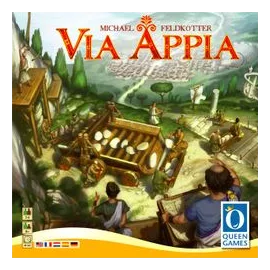
Players build the city of Pompeii in a 7x7 grid using cards that each show various building types, numbers and colors. The same building types and colors may never be placed horizontally or vertically adjacent. During placement, horizontal, vertical and diagonal "streets" emerge,...
Players
2-4
Time
?-?
Age
12+
Weight
1.56
Rating
6.24
Should this hit the table?
Pompeji has a high level of direct confrontation and strategic depth in confrontation. Players need to frequently pay attention to and react to others' strategies and turns. However, there is less emphasis on cooperation in the game.
Teaching signal
High replayability
Highly interactive
Scales well
Deep strategy
Luck-sensitive
Pompeji has a high level of direct confrontation and strategic depth in confrontation. Players need to frequently pay attention to and react to others' strategies and turns. However, there is less emphasis on cooperation in the game.
Pompeji has a high variability gameboard, offering different experiences each time it is played. The presence of expansions adds new content and gameplay elements, enhancing replay value. The game provides deep strategic possibilities and room for players to improve their tactics and strategies. The player interaction score is average. The game scales well with different numbers of players without compromising its appeal or balance. It is relatively easy to learn, making it accessible to a wide range of players. Overall, Pompeji has a strong replayability score of 7.85.
Pompeji has a moderate influence of luck. Random elements like dice rolls or card draws have a notable impact on the game outcome, but players also have substantial ability to mitigate randomness through strategic decisions and planning. The game is a balanced mix of luck and strategy, with neither element dominating the outcome.
Overview
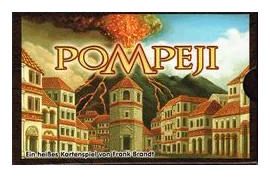
Players build the city of Pompeii in a 7x7 grid using cards that each show various building types, numbers and colors. The same building types and colors may never be placed horizontally or vertically adjacent. During placement, horizontal, vertical and diagonal "streets" emerge, and players score points when they place cards with elements that match other cards along a street. Thus, with each placement, a player has the potential to score points along 4 different streets - 2 diagonal, 1 vertical and 1 horizontal. If a card's color matches others in a street, the player scores points equal to the highest-valued card of that color. If a card's building matches others in a street, the player receives the total sum value of all the matching buildings. Players receive a 7-point bonus for placing the 7th building in a road. Players also receive one special building permit card that allows an extra or out-of-turn play and one statue card, which acts as a wild card. The game ends when the second of two volcano cards in the deck is revealed.

Media
Images, galleries, and videos are grouped here so the page feels visual before every asset is fully hosted.
Editions
| Edition | Year | Language | Publisher / Region |
|---|---|---|---|
| No editions imported yet. | |||
Files and documents
No files imported yet.
Commerce mapping
Credits
Linked items
Related games and expansions help build a connected catalog around every title.
No linked items imported yet.