Overview
At a glance
Is this game right for my group?
ABG editorial scores on a 1–5 scale.
Harder to teach
High replayability
Highly interactive
Scales well
Deep strategy
How it plays
How does it play?
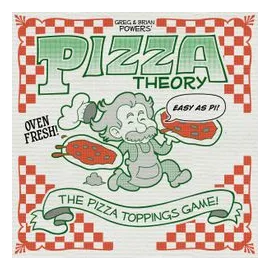
Pizza Theory, designed for exactly three players, has no randomness and simple turn actions, but the outcome each round is unpredictable since each cook has his own idea for the best way to create the pie.
Core mechanisms
Key systems that shape the decisions players make.
Read the full game description
Pizza Theory, designed for exactly three players, has no randomness and simple turn actions, but the outcome each round is unpredictable since each cook has his own idea for the best way to create the pie. To set up the game, each player takes his pizza cutter (a wooden stick) and the die and topping counters that match. Each player places two toppings on the game board in the spaces designated with an X. In each round, the three players take turns placing one topping on the game board; that topping cannot be placed adjacent to any of that player's other toppings. Each player then secretly chooses a number (1-6) on his die; players reveal the numbers and lay their pizza cutters on the board in the space matching their number. The cutters divide the pizza into one of 216 possible outcomes, creating a number of slices. In each slice if a player has more toppings than each opponent, he replaces those opponent's toppings with his own; if two players tie for the most toppings, the toppings of the third player are removed but not replaced; in a three-way tie, nothing changes. (NB: If a player has at most one topping in each slice, then his toppings cannot be removed or replaced this round.) Whoever first places his 16 toppings on the game board wins. With only two players, the cutter and toppings of the third color are still used, with players taking turns placing those toppings on the board. If all 16 toppings of the third color are on the board before either player gets his toppings on the board, then both players lose.