Overview
At a glance
Is this game right for my group?
ABG editorial scores on a 1–5 scale.
Harder to teach
High replayability
Highly interactive
Scales well
Deep strategy
How it plays
How does it play?
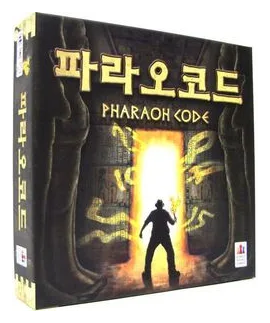
In Pharaoh Code, you're trying to claim as many scarabs as you can by solving the aforementioned codes. To set up the game, you divide the number tiles into four piles based on the number of scarabs on them, with more scarabs typically signifying larger numbers.
Core mechanisms
Key systems that shape the decisions players make.
Read the full game description
In Pharaoh Code, you're trying to claim as many scarabs as you can by solving the aforementioned codes. To set up the game, you divide the number tiles into four piles based on the number of scarabs on them, with more scarabs typically signifying larger numbers. To create the number pyramid, you lay out one tile with four scarabs, two tiles with three, and so on. On a turn, one players rolls the three dice – an octahedron, a decahedron and a dodecahedron – then all players try to use the four fundamental arithmetic operations to transform the numbers on two or three of the dice to match one of the numbers on a tile. For example, amongst the cards on the board is a 72 and you rolled two 8s and one 1; you can calculate 8 x (8 + 1) and the result is 72. As soon as a player has reached a target number, she takes that tile off the game board, then flips the thirty-second sand timer. Everyone else can grab one tile during this time, then once time expires the players must demonstrate how they reached the number in question. If a player calculated correctly, she keeps the tile face-up; otherwise she flips it face-down as a penalty. Players then fill up empty spaces on the game board, then roll the dice again to start another round. As soon as a row cannot be filled, the game ends. Players then tally the scarabs they collected, subtract penalty scarabs, and see who has the highest score.