Overview
At a glance
Is this game right for my group?
ABG editorial scores on a 1–5 scale.
Harder to teach
High replayability
Highly interactive
Scales well
Deep strategy
How it plays
How does it play?
Roughly translated as 'Robbers', this abstract battle game was known to be played by the Romans, and versions of the same game may well have been played before by the Ancient Greeks and Egyptians, and afterwards by the Persians.
Core mechanisms
Key systems that shape the decisions players make.
Read the full game description
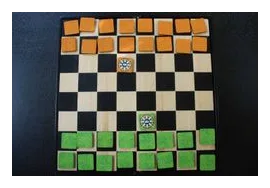
Roughly translated as 'Robbers', this abstract battle game was known to be played by the Romans, and versions of the same game may well have been played before by the Ancient Greeks and Egyptians, and afterwards by the Persians. Games archaeologists and historians disagree hotly about just about every aspect of this game: board size, number and distribution of playing pieces, use of a king piece, age, priority, etc, etc; the list goes on. However, there is evidence that the game existed, both in literature and in archaeological finds. All this disagreement suggests that, as the game traveled out to the far flung regions of empire, it was altered and developed by gamers and gamblers. The basic Latrunculi consists of 1, 2, or 3 ranks of opposing pieces (the number differs), on a board divided into squares of a single color; the board itself could be 8x8, 10x10, 12x8, or variations thereof. The move of the pieces is a matter for discussion: the rook's move, queen's move, king's move from chess, or one square orthogonally have all been suggested. Capture is made when a piece has opposing pieces on either side of it. The winner is the player who captures all his opponent's pieces, although variations have been suggested, such as getting two pieces to the opponent's back rail. As noted above, many variations exist, including a version recently discovered in Colchester (the Roman capital of England, Camulodonum), which includes a 'king' or 'standard' piece. Games of the Hnefatafl family are probably further developments of Latrunculorum. BGG members will no doubt have disagreements, opinions, and variations to add to this 'base-line' summary. Moshe Callen is credited as a designer on this game for his work in researching, developing, and formalizing the rules of the game based on historical data for the nestorgames version of this game.