ABG All Board Games
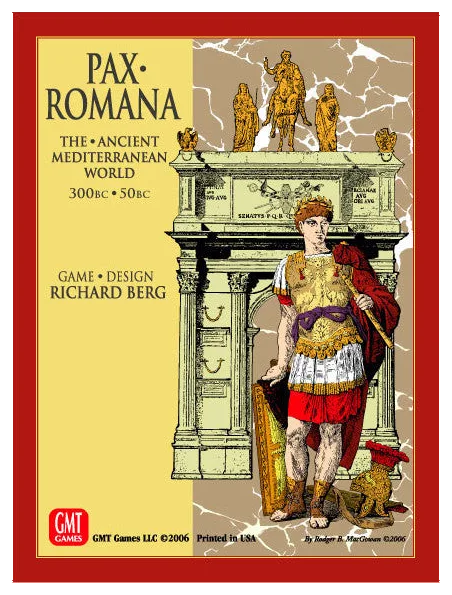
Pax Romana box art
Rich game profile

Pax Romana

How did Rome get to be Rome? Why did the Glory That Was Greece fade? What stopped Carthage from making an empire of the Mediterranean? Could the Seleucids really have conquered the western world? PAX ROMANA covers Europe from 300 BC through the end of the 1st century BC, when con...

Players

2-4

Time

?-?

Age

12+

Weight

3.67

Rating

7.41

Should this hit the table?

Quick read before the metadata.

Moderate level of interaction with a mix of direct and strategic confrontation.

Teach 2.3

Teaching signal

Replay 3.9

High replayability

Interaction 3.6

Highly interactive

Scaling 4.0

Scales well

Strategy 4.5

Deep strategy

Control 3.8

More strategic control

Table feel

Moderate level of interaction with a mix of direct and strategic confrontation.

Replay value

Pax Romana has a high variability gameboard, offering different experiences each time it is played. The presence of expansions adds new content and gameplay elements, enhancing replay value. The game provides deep strategic possibilities and room for improvement over time. The player interaction score is moderate. It scales well with different numbers of players without compromising its appeal or balance. The game is moderately easy to learn, offering a balance between accessibility and depth. Overall, Pax Romana has a strong replayability score of 7.85.

Luck profile

Pax Romana has a moderate level of luck influence. While random elements have minimal impact on the game outcome, players have substantial ability to mitigate randomness through strategic decisions and planning. The game outcome is primarily determined by player strategy and decisions, with luck playing a minor role.

Overview

What ABG knows about this game

How did Rome get to be Rome? Why did the Glory That Was Greece fade? What stopped Carthage from making an empire of the Mediterranean? Could the Seleucids really have conquered the western world? PAX ROMANA covers Europe from 300 BC through the end of the 1st century BC, when control of the Mediterranean was in a state of flux with four empires possible. The emphasis is on strategic operations, from raising armies to colonizing outlying areas, to fighting barbarian incursions, to maintaining political stability at home. PAX uses a unique marker-oriented play sequence that provides surprise and opportunity, plus a deck of unusual cards that provide the historical background of events and calamities within which the players must operate. PAX provides wide variety of scenarios, from fast-playing, one-sitting two-player games to vivid recreations of the entire era with four players. The game works well with 2, 3 or 4 players, and is designed to be playable solitaire for those interested in the historical view it provides. Scenarios range from The Punic Wars, through the Eastern Med conflicts between the Greeks and the Seleucids, all the way up to the entire 10 turn game, covering 300 years of history. In addition, there are two versions of PAX: the Standard Game, designed for fast play, and the Advanced version, which adds in much tangential history and allows for a more introspective examination of the era. PAX ROMANA includes one gamemap, 55 cards, 400+ counters, and a host of play aids and charts to keep things organized.
Media

Images and visual references

Images, galleries, and videos are grouped here so the page feels visual before every asset is fully hosted.

Editions

Versions and regional releases

Edition Year Language Publisher / Region
No editions imported yet.

Files and documents

Rules, aids, translations

No files imported yet.

Credits

People and publishers

Designers

1
Richard H. Berg

Artists

4
Knut Grünitz Mike Lemick Rodger B. MacGowan Mark Simonitch

Publishers

1
GMT Games

Linked items

Graph expansion queue

Related games and expansions help build a connected catalog around every title.

No linked items imported yet.