Overview
At a glance
Is this game right for my group?
ABG editorial scores on a 1–5 scale.
Harder to teach
High replayability
Highly interactive
Scales well
Deep strategy
How it plays
How does it play?
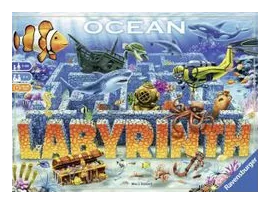
Ocean Labyrinth uses the same basic game play as Ravensburger's decades-old title The aMAZEing Labyrinth. Players try to move through a labyrinthine game board in order to reach a desired symbol shown on a game board tile that matches a hidden card held by this player.
Core mechanisms
Key systems that shape the decisions players make.
Modular Board
Build the play area from interchangeable sections that vary between games.
Network and Route Building
Create connected routes that improve reach, delivery, control, or scoring.
Tile Placement
Place tiles to build a shared or personal spatial arrangement.
Point-to-Point Movement
Move along explicit connections between named locations or nodes.
Read the full game description
Ocean Labyrinth uses the same basic game play as Ravensburger's decades-old title The aMAZEing Labyrinth. Players try to move through a labyrinthine game board in order to reach a desired symbol shown on a game board tile that matches a hidden card held by this player. The game board consists of a number of fixed tiles as well as rows and columns in which tiles can slide back and forth; these tiles show tunnels – T-shaped, straight, and otherwise – and a player can move his token only along the path as it exists on his turn. At the start of his turn, however, he takes the one tile on the side of the game board and pushes it into a row or column of his choice, shifting the tunnels and pushing out one tile that the next player will use. This player now moves his pawn, and if he reaches the desired symbol, he reveals the card, then looks at the next card in his stack to see what he wants to reach next turn. Once a player has revealed all of his cards, he needs to return to his starting corner. The first player to do this wins! To this basic game, Ocean Labyrinth adds an underwater theme and a twist: some tiles have special rules on their backsides. When a tile of this type is pushed out, a special rule is used for the next turn: Pufferfish: the current player is so scared from this fish that they lose their movement for the current turn. Diving scooter: you move more quickly: take an additional turn Oxygen tank: you don't have enough oxygen, so you must return your pawn to a freely chosen start tile.