Overview
At a glance
Is this game right for my group?
ABG editorial scores on a 1–5 scale.
Harder to teach
High replayability
Highly interactive
Scales well
Deep strategy
How it plays
How does it play?
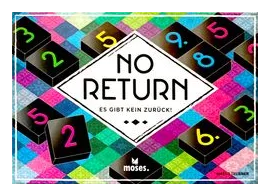
No Return: Es gibt kein zurück! ("There's No Turning Back!") is played in two phases, with players collecting tiles in phase one, then scoring their tiles in phase two.
Read the full game description
No Return: Es gibt kein zurück! ("There's No Turning Back!") is played in two phases, with players collecting tiles in phase one, then scoring their tiles in phase two. People move into phase two at their own pace, and once you go in, you're there for the rest of the game — which might not be long! The game includes 132 tiles, specifically two sets of tiles in six colors, with the tiles being numbered 1-11 in each color. Each player starts with eight tiles in hand, and you can discard and redraw once before the game begins. On a turn, you either (1) discard up to four tiles in your hand from the game, then draw that many tiles from the bag or (2) play one or more tiles from your hand to a color on your board, then draw that many tiles. You can play tiles of only one color, and all the tiles played must be equal to or less than any tiles of that color you already have in play. You place these tiles in descending order, and you can build at most six rows during the game, one of each color. Whenever you want, you can switch to phase two. Once you do this, on a turn you either (1) discard up to four tiles in your hand from the game, then draw that many tiles from the bag or (2) clear tiles from your play area to score them. To do this, choose one or more tiles in your play area of only a single color, starting with the lowest valued tile (or tiles), then sum the tiles you want to score. You must then "pay" to score these tiles by discarding tiles of one color from your hand that sum to this same amount or higher. The tiles you discard from your hand don't have to be the same color as the color of the tiles you're scoring. Remove the tiles you paid from the game, and place the tiles you've cleared face down in a score pile. Refill your hand to eight tiles at the end of your turn. As soon as someone draws the final tile from the bag, you complete the round so that everyone has had the same number of turns, then the game ends. A player's score equals the sum of the tiles that they've cleared minus the sum of the tiles they still have in play. (Tiles in a player's hand are discarded.) Whoever has the highest score wins!