Overview
At a glance
Is this game right for my group?
ABG editorial scores on a 1–5 scale.
Easier to teach
High replayability
Low interaction
Scales well
Light strategy
More strategic control
How it plays
How does it play?
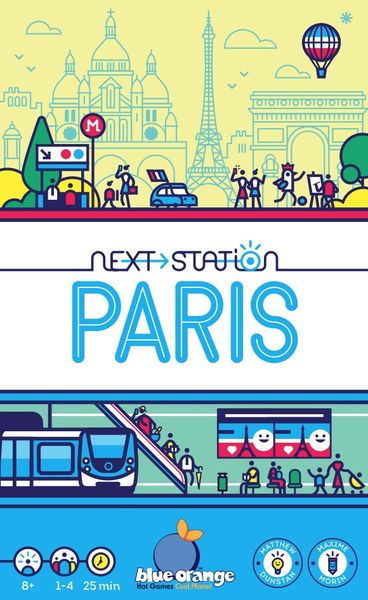
Draw Paris metro lines one card at a time, cross the Seine, connect monuments and districts, and exploit the central platform without creating illegal overlaps.
Core mechanisms
Key systems that shape the decisions players make.
Network and Route Building
Create connected routes that improve reach, delivery, control, or scoring.
Line Drawing
Draw lines to connect, divide, trace, or claim parts of the play area.
Paper-and-Pencil
Record choices and results directly on a personal sheet.
Bingo
Mark matching results on a personal grid and complete required patterns.
Connections
Create meaningful links between locations, pieces, or concepts.
End Game Bonuses
Earn additional points for meeting conditions evaluated when the game ends.
Read the full game description
Next Station: Paris is a compact flip-and-write network puzzle set beneath the streets of the French capital. Each round gives one player a colored pencil and everyone the same sequence of station cards. Every card asks you to extend the active metro line toward a matching symbol, but routes cannot retrace existing track or cross except at permitted stations. Paris adds overhead crossings and a central platform that can turn a constrained map into an efficient web if you approach it from the right direction. Points reward serving multiple districts, visiting landmarks, crossing the Seine, and creating useful interchanges, so the shortest legal line is rarely the best one. After four rounds, every player has drawn all four colors, yet the resulting networks can be dramatically different. It is quick to teach, simultaneous to play, and rich in small spatial decisions, with no downtime and a fresh planning problem in every shuffled card order.