Table feel
Moderate level of direct and strategic confrontation with high interaction frequency, but low emphasis on cooperation.
Players
1-2
Time
?-?
Age
12+
Weight
2.75
Rating
5.79
Teaching signal
High replayability
Highly interactive
Scales well
Deep strategy
More strategic control
Moderate level of direct and strategic confrontation with high interaction frequency, but low emphasis on cooperation.
Napoleon's Later Battles I has a high replayability score due to its high variability, strategic depth, and scalability. The game offers different experiences each time it is played, with multiple paths to victory and variable setups. The presence of expansions adds new content and gameplay elements, enhancing the replay value. The game also allows players to improve their strategy over time, discovering new tactics and strategies. It adapts well to different player counts without compromising its appeal or balance. While it may take some time to learn, the depth it offers makes it worth the effort.
The final luck score for Napoleon's Later Battles I is 7.67, indicating a low influence of luck. The game relies more on player decisions and strategy rather than random elements. Strategic decisions and planning have a substantial ability to mitigate randomness, allowing players to have control over the outcome. Overall, luck plays a minor role in determining the game's outcome.
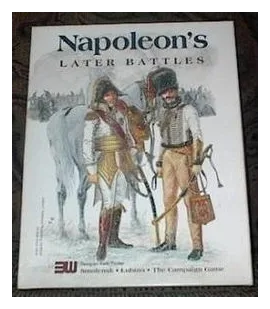
A more or less traditional hex & counter war game covering Napoleon's battles at Smolensk and Lubino, as well as a campaign game that allows players to play through the what-ifs that could have happened. Contains two maps, both 34"x22" and about 400 counters, as well as other game components. This particular game is rated highly for solitaire play.
No media imported yet.
| Edition | Year | Language | Publisher / Region |
|---|---|---|---|
| No editions imported yet. | |||
No files imported yet.
No linked items imported yet.