Overview
At a glance
Is this game right for my group?
ABG editorial scores on a 1–5 scale.
Harder to teach
High replayability
Highly interactive
Scales well
Deep strategy
How it plays
How does it play?
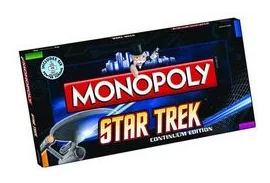
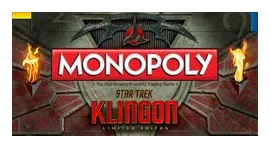
A spinoff of the original 1935 Hasbro game, this 2011 Klingon edition (released November 17th) follows the same format. There is a "Go" square in one corner, and players roll dice to travel around the squares lining the edge of the board in circles trying to acquire properties.
Core mechanisms
Key systems that shape the decisions players make.
Auction/Bidding
Bid against other players to determine who receives an item, action, or priority.
Set Collection
Gather related items that become more valuable when scored together.
Trading
Exchange resources, assets, or promises with other players.
Player Elimination
Players can be removed from contention before the game ends.
Roll-and-Move
Roll dice or spin a dial to determine how far a piece moves.
Read the full game description
A spinoff of the original 1935 Hasbro game, this 2011 Klingon edition (released November 17th) follows the same format. There is a "Go" square in one corner, and players roll dice to travel around the squares lining the edge of the board in circles trying to acquire properties. What seems like the biggest difference between the editions (i.e. the fact that you are trying to take over the galaxy) actually involves no changes from the original edition other than name changes. "Properties" are "galaxy systems" such as Qo'noS, Romulus or Earth (home base of the enemy Federation), and they are "conquered" instead of "owned". The most ultimately valuable "property" (equivalent to Boardwalk in the original game), is now called Kronos, and the equivalent of Park Place is Khitomer. The equivalents of the valuable green properties in the original are Boreth, Ty’Gokor and Krios Prime, and so on. The standard money is replaced by "Klingon Force" scrip. "Houses" are renamed "Outposts" (and redone as small yellow dome-shaped constructs) and "Hotels" are renamed "Capitals" (miniature red versions of the Klingon High Council Building). "Railroads" are "Starships": the Raptor, the Negh'Var, the Vor'Cha and the K'T'inga; and the "Utilities" are now the Rura Penthe Mines and the Praxis Energy Facility. The REAL differences lie in the facts that, for one, "Combat" cards replace "Chance" cards. Furthermore, the element of "Honor" replaces the "Community Chest". The penalty of the "Luxury Tax" is replaced by a penalty of losing a battle against Starfleet. Another difference which does not affect gameplay, but which does add a lot to the feel of the game is that the board, cards, and rules are all bi-lingual: written in both Klingon and English. In order to attain victory and "preserve the glory of the Klingon Empire", players must conquer all of the systems in the galaxy. Two editions were released, a standard "Collector's Edition" and a 1701-unit-released "Limited Edition" that includes a miniature replica of Chancellor Gorkon's bone cane from STAR TREK VI: THE UNDISCOVERED COUNTRY. Both versions include as standard equipment: the gameboard, 6 Collectible tokens, 28 Title Deed Cards, 16 COMBAT cards, 16 HONOR cards, 2 Dice, 32 Outposts, 12 Capitals, 1 Pack of Klingon Forces, and Rules. Like most of their MONOPOLY releases, this does not include the "Speed Die", although the rules mention both classic "speed-up game" options.