Overview
At a glance
Is this game right for my group?
ABG editorial scores on a 1–5 scale.
Harder to teach
High replayability
Highly interactive
Scales well
Deep strategy
How it plays
How does it play?
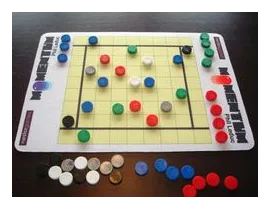
Momentum is a dynamic abstract strategy board game in which the lead swings back and forth like the steel spheres of Newton’s cradle. Grabbing the lead and holding onto it is the challenge.
Core mechanisms
Key systems that shape the decisions players make.
Read the full game description
Momentum is a dynamic abstract strategy board game in which the lead swings back and forth like the steel spheres of Newton’s cradle. Grabbing the lead and holding onto it is the challenge. The mechanics of the game simulate the game of marbles. Players take turns dropping one of their eight marbles (glass stones) onto a square 7 x 7 game board. On the second player’s first turn only, the second player may either drop a counter or replace the first player’s dropped counter with one of his or her own (Pie Rule). The momentum of the dropped marble is transferred in up to eight (orthogonal and diagonal) directions through adjacent contiguous lines of marbles. The last marble at the end of each of these lines is pushed away one cell from the dropped marble. Some fall off the board and are returned to the owning players. When a player has only one marble left in hand, he or she is required to announce the last marble. At which point, his opponent is forced to knock at least one of his other seven marbles off the board, otherwise the opponent would lose the game. The first player to have all eight of his or her marbles on the board at the end of his or her turn wins the game. For beginners and perpetual games the following rule applies to the standard 7 x 7 game. 30-Rounds Rule (Optional, recommended for beginners): If a game lasts for 30 rounds (60 player turns), play stops and the outcome is determined. If either player has a majority of marbles on the board that player wins, if not, the game ends in a draw. Players can use a spare token to keep track of rounds by using the outside edge of the board. Once around is 28 steps. Two more rounds and the game ends.