Overview
At a glance
Is this game right for my group?
ABG editorial scores on a 1–5 scale.
Harder to teach
High replayability
Highly interactive
Scales well
Deep strategy
How it plays
How does it play?
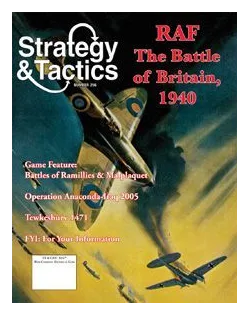
Originally published in Strategy & Tactics magazine #256 (May/Jun 2009). Marlborough’s Battles: Ramillies and Malplaquet is a wargame of intermediate complexity, designed by Richard H.
Core mechanisms
Key systems that shape the decisions players make.
Grid Movement
Move pieces between adjacent spaces on a regular grid.
Dice Rolling
Roll dice to introduce uncertainty into actions, production, movement, or resolution.
Hexagon Grid
Use a hexagonal map where each space connects evenly in six directions.
Line of Sight
Visibility between pieces determines valid targets, movement, or effects.
Read the full game description
Originally published in Strategy & Tactics magazine #256 (May/Jun 2009). Marlborough’s Battles: Ramillies and Malplaquet is a wargame of intermediate complexity, designed by Richard H. Berg, covering two of the Duke’s great victories in the War of the Spanish Succession: Ramillies, a massive cavalry clash, and Malplaquet, a hue infantry battle. The period in which Marlborough fought was a transition between the musket-and-pike era and the more fluid, if still massed, tactics that emerged with Frederick the Great. The key transitional mechanic was the invention of the socket bayonet, which allowed gun-armed infantry to use their weapon for shock as well as fire combat. The battles fought in the War of the Spanish Succession were the first major engagements in which that innovation was used, and the commanders hadn’t yet learned to appreciate its value. Warfare in that era was therefore mostly still formalized, rigid and stolid. The map scale is 225 yards per hex. Each double-length infantry unit is composed of, on an average, four battalions and contains about 2,000 to 3,000 tightly packed men. The square infantry counters (for use in Malplaquet) each represent about half that number. Cavalry units each contain about five or six squadrons, about 600 mounted men. Artillery units each represent 12 to 18 guns. There is no per-turn time scale, as there are no distinct game turns. The game simply starts and then keeps going until one player wins. To accomplish that the system uses a “continuation activation” mechanic.