Overview
At a glance
Is this game right for my group?
ABG editorial scores on a 1–5 scale.
Harder to teach
High replayability
Highly interactive
Scales well
Deep strategy
How it plays
How does it play?
From the ashes of war, nations rise to power in the atomic age. Each player takes control of a nation struggling for power in the latter part of the 20th century.
Core mechanisms
Key systems that shape the decisions players make.
Dice Rolling
Roll dice to introduce uncertainty into actions, production, movement, or resolution.
Die Icon Resolution
Interpret rolled icons to determine which actions or effects occur.
Variable Player Powers
Each player has different abilities, restrictions, or strategic advantages.
End Game Bonuses
Earn additional points for meeting conditions evaluated when the game ends.
Events
Triggered events alter the shared state, rules, or available choices.
Read the full game description
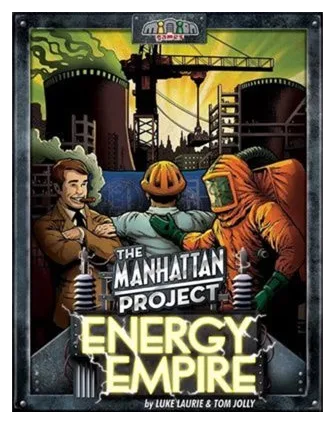
From the ashes of war, nations rise to power in the atomic age. Each player takes control of a nation struggling for power in the latter part of the 20th century. They build up their nation’s industry, commerce, and government by acquiring resources, building structures, and tapping sources of energy. The price of oil is going up, and nuclear energy is the wave of the future. The Manhattan Project: Energy Empire is set in the same "universe" as The Manhattan Project, but it's a standalone game, not an expansion. The major threat in Energy Empire is not war, but uncertain global impacts, that result from side effects of industrialization and pollution. Many actions come with a cost. So, as nations become more industrious, they also increase the amount of pollution in the environment. Careful use of science can mitigate the harmful effects of industry, and can also help avert global crises. Energy Empire uses worker placement, tableau-building, and resource management mechanics. On each turn, a player can choose to either work or generate. On a work turn, a player plays a single worker on the main board, then uses workers and energy to activate cards in their tableau. Players may spend energy to use an occupied space on the main board, so no spaces are ever completely blocked. On a generate turn, players get to renew their supply of energy by rolling "energy dice" that represent nuclear, coal, oil, solar, and other forms of energy.