Overview
At a glance
Is this game right for my group?
ABG editorial scores on a 1–5 scale.
Harder to teach
High replayability
Highly interactive
Scales well
Deep strategy
How it plays
How does it play?
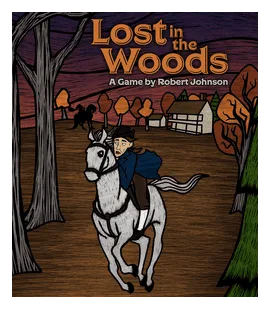
Lost in the Woods is a solo game set on the eve of Ichabod Crane's fateful ride home at the end of the original story of Legend of Sleepy Hollow.
Core mechanisms
Key systems that shape the decisions players make.
Read the full game description
Lost in the Woods is a solo game set on the eve of Ichabod Crane's fateful ride home at the end of the original story of Legend of Sleepy Hollow. Players must guide Ichabod from the Van Tassel mansion through the forest to the covered bridge before time runs out and the Headless Horseman chases him down. Players will need to push their luck, avoid frights, and keep their wits to get Ichabod safely home! In the game, one player will have 60 minutes (12 units of Time) to travel across 9 Woods cards in the Forest Row and reach the Covered Bridge. To do so, players will draw cards from the Journey Deck, typically placing them next to the deck to form the Fright Row. Woods cards that appear will have one of three good luck symbols on them. When there are two or more Woods cards in the Fright Row with a matching symbol, the player can spend one Time to take one of each matching Woods cards and place them into the Forest Row. The catch is that Woods cards cannot be placed in the Forest Row next to another Woods card that has the same good luck symbol. Fright cards may appear from the Journey Deck, as well. These three cards - a wolf, a bat, and an owl - are placed into the Fright Row. If at any time there is a matching pair of Fright cards in the Fright Row, the entire Fright Row is discarded. If there was a matching set of Woods cards in the Fright Row then the player loses no time. If not, the player loses one Time. If there are ever three different Fright cards in the Fright Row then the entire Fright Row is discarded and the player loses two Time. There are also several Event cards in the deck that, when drawn, trigger an effect and are discarded. These can range from the Torch which allows the player to discard Fright cards from the Fright Row, to the Headless Horseman himself which forces the player to discard the lead Woods card in the Forest Row if there are any Fright cards in the Fright Row.