Overview
At a glance
Is this game right for my group?
ABG editorial scores on a 1–5 scale.
Harder to teach
High replayability
Low interaction
Scales well
Deep strategy
How it plays
How does it play?
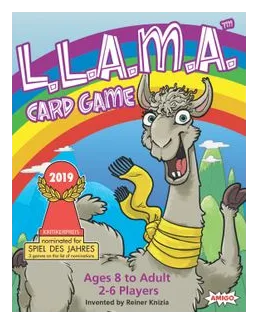
In LLAMA, you want to dump cards from your hand as quickly as you can, but you might not be able to play what you want, so do you quit and freeze your hand or draw and hope to keep playing?
Core mechanisms
Key systems that shape the decisions players make.
Hand Management
Time and sequence a limited hand of cards to preserve future options.
Push Your Luck
Choose whether to secure current gains or risk them for a larger reward.
Ladder Climbing
Play increasingly strong combinations until opponents cannot or choose not to respond.
Matching
Pair items with corresponding symbols, properties, or categories.
Read the full game description
In LLAMA, you want to dump cards from your hand as quickly as you can, but you might not be able to play what you want, so do you quit and freeze your hand or draw and hope to keep playing? Each player starts a round with six cards in hand; the deck consists of llama cards and cards numbered 1-6, with eight copies of each. On a turn, the active player can play a card, draw a card, or quit. To play a card, you must play the same number as the top card of the discard pile or one number higher. If a 6 is on the discard pile, you can play a 6 or a llama, and if a llama is on top, you can play another llama or a 1. If you quit, you place your remaining cards face down and take no further actions in the round. If all players have quit but one, that player can continue to play, but cannot draw more cards. The round ends when one player empties their hand or all players have quit. In either case, players collect tokens based on the cards in their hand. Each different number card in hand gets you white tokens (each worth 1 point) equal to the value of the card while one or more llamas gets you a black token (worth 10 points). (You can exchange ten white tokens for one black token at any time.) If you played all your cards, you can return one token (white or black) that you previously collected to the supply. You then shuffle all the cards and begin a new round, in which the first player to play will be the one who emptied their hand or was the last one to quit in the previous round. The game ends at the end of the round where at least one player has forty or more total points. Whoever has the fewest points wins! The original title of this game is a German acronym and stands for Lege alle Minuspunkte ab, that is, "discard all minus points", with "Lama" also being the German spelling of "llama". The Polish game Lato z Komarami features gameplay nearly identical to LLAMA except that the game has one less "llama" card, and the penalty for llama cards in hand is 10 points per card, instead of being 10 points for one or more llama cards.