Overview
At a glance
Is this game right for my group?
ABG editorial scores on a 1–5 scale.
Harder to teach
High replayability
Highly interactive
Scales well
Deep strategy
How it plays
How does it play?
On November 30, 1803, the United States purchased Louisiana from Napoleon. U.S.
Core mechanisms
Key systems that shape the decisions players make.
Deck / Bag Building
Add new pieces during play to improve the cards, tokens, or dice drawn later.
Action Retrieval
Previously used actions must be recovered before they can be selected again.
Hand Management
Time and sequence a limited hand of cards to preserve future options.
Open Drafting
Select cards or items from a shared face-up display.
Delayed Purchase
Commit to a purchase before receiving the item or paying its full cost.
Read the full game description
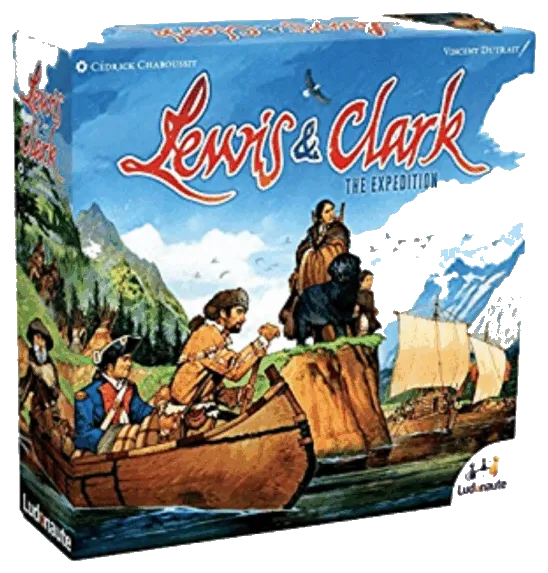
On November 30, 1803, the United States purchased Louisiana from Napoleon. U.S. President Thomas Jefferson decided to send two explorers – Meriwether Lewis and William Clark – to discover this huge terra incognita. Lewis & Clark is a board game in which each player manages an expedition intended to cross the North American continent. Their goal is to be the first to reach the Pacific. Each one has his own Corps of Discovery that will be completed by the Native Americans and the trappers met during the journey. He has to cleverly manage his characters and also the resources he finds along the way. Beware, sometimes frugality is better than abundance. Lewis & Clark features dual use cards. To be activated, one card must be combined with another one, which becomes unavailable for a while. Thus, players are faced with a constant dilemma: play a card or sacrifice it. During the game, each player acquires character cards that enlarge his hand, building a crew that gives him more options but it needs to be optimized as he will recycle his cards more slowly. This new "handbuilding" mechanism fits strongly with the historical background. Since the aim of the game is to be the first on the Pacific coast, the timing and the opportunistic use of the other players' positions are crucial.