Overview
At a glance
Is this game right for my group?
ABG editorial scores on a 1–5 scale.
Harder to teach
High replayability
Highly interactive
Scales well
Deep strategy
How it plays
How does it play?
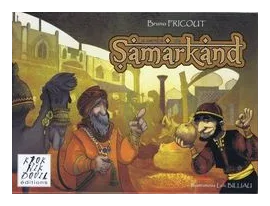
Le Marché de Samarkand is a game of Dutch bids, a bid where the salesman leaves a maximum price and comes down then until a buyer stops the process. Here, everything is made in the voice, the quickest being the first one to be listened.
Core mechanisms
Key systems that shape the decisions players make.
Read the full game description
Le Marché de Samarkand is a game of Dutch bids, a bid where the salesman leaves a maximum price and comes down then until a buyer stops the process. Here, everything is made in the voice, the quickest being the first one to be listened. Every player has a set of 10 cards of the same goods but various values. In every tour, each chooses it a which are releases together. Master of the souk begins then to shell the values from 10. As soon as he wishes it, a player can stop the discount to buy one of the cards releases which he pays then to his owner. If two players want the same card at the same price, no sharing: they have nothing but pay all the same the salesman! Once arrived at zero, the remaining cards are straightened. Each is then going to meet with a lot of cards of various colors. He cannot keep that certain number, function of the camels which will have been acquired during the party. These last ones are put on sale at the same time as the goods and purchasable by auction also. Every card Camel has a transport capacity and it is necessary to have, ideally, the same number of cards Goods in the end, at the risk of penalties. The lot of cards, to mark points, has its lot of constraints. At the end of the party, each considers at first the number of goods obtained in the least numerous color. What means that with a missing color, it is zero of marked. In it, it is necessary to add points according to the number of cards obtained according to their value, and not to the color. For example, with four cards of the same value, it makes four points. With five, we pass in eight points. Side penalties, every free place on a camel costs two points. it is going to need to aim just. The winner is the one who adds up most of points of victory at the end of the discount.