Overview
At a glance
Is this game right for my group?
ABG editorial scores on a 1–5 scale.
Harder to teach
High replayability
Highly interactive
Scales well
Deep strategy
How it plays
How does it play?
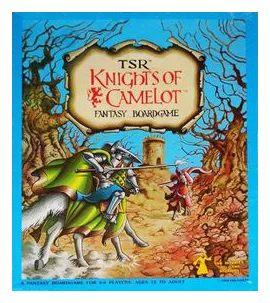
Knights of Camelot ranks right alongside Divine Right; it is an early TSR game brimming with flavour. The players are freshly knighted and wander the Arthurian realm looking for damsels in distress, brigands, monsters, other knights to joust with, etc.
Core mechanisms
Key systems that shape the decisions players make.
Alliances
Players can cooperate through temporary or formal partnerships while pursuing victory.
Area Movement
Move pieces between connected regions rather than along individual spaces.
Dice Rolling
Roll dice to introduce uncertainty into actions, production, movement, or resolution.
Paper-and-Pencil
Record choices and results directly on a personal sheet.
Events
Triggered events alter the shared state, rules, or available choices.
Read the full game description
Knights of Camelot ranks right alongside Divine Right; it is an early TSR game brimming with flavour. The players are freshly knighted and wander the Arthurian realm looking for damsels in distress, brigands, monsters, other knights to joust with, etc. The game uses a random table generation driver that can lead to an enormous variety of encounters. I remember fondly two incidents: In the first, a knight met a Dwarf on a horse. Deciding to approach and meet him (instead of avoiding or charging), the dwarf turned out to be a knight in disguise—but not just any knight! It was Lancelot, the foremost knight of the realm! We had a sudden vision of the hollowed-out horse necessary to hide Lancelot's bulk… In another incident, a player led a charmed life and pulled ahead of the others in their quest for the Holy Grail. He met Merlin repeatedly and ended up with a special charger, magic lance, and magic shield—the works! England wasn't much of a challenge for him any more, so he decided to cross the Channel to France. Bad move! His ship sank in a storm so he washed up on the shore minus all his equipment and followers. Dejected, he trudged to the nearest castle to ask for help—but a giant jumped out of the moat and killed him in one blow! The game has heavy role-playing elements to it; articles in Dragon Magazine, Issue# 58 explained how one could play knaves (bad knights), and GMs have been known to use the game as an adventure generator for RPGs.