Overview
At a glance
Is this game right for my group?
ABG editorial scores on a 1–5 scale.
Harder to teach
High replayability
Highly interactive
Scales well
Deep strategy
How it plays
How does it play?
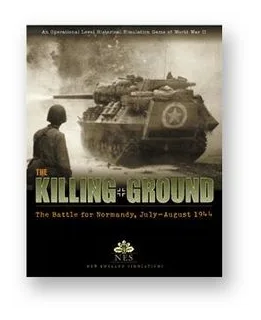
New England Simulations revisits a familiar World War II venue -- the hedgerows of Normandy -- with some refreshing twists in The Killing Ground: Campaign for Normandy, July-August 1944".
Core mechanisms
Key systems that shape the decisions players make.
Grid Movement
Move pieces between adjacent spaces on a regular grid.
Dice Rolling
Roll dice to introduce uncertainty into actions, production, movement, or resolution.
Chit-Pull System
Draw tokens to determine which units, factions, or events activate next.
Movement Points
Spend a movement allowance across spaces with different costs.
Hexagon Grid
Use a hexagonal map where each space connects evenly in six directions.
Read the full game description
New England Simulations revisits a familiar World War II venue -- the hedgerows of Normandy -- with some refreshing twists in The Killing Ground: Campaign for Normandy, July-August 1944". The game combines a mechanic usually reserved for smaller games -- a chit pull combat system -- with two gorgeous maps, 900 counters, and a 36-page rulebook that should have "Don't Panic!" inscribed on its cover (the designer was content to place the warning on the first page of rules instead). As you read the rules, you get the feeling that the designer wants to bring back the best parts of the "good old days" of wargaming -- that newfound excitement and thrill you once had that gradually wore off as you slogged through the complexity of the latest SPI monster. The rulebook is written almost in prose, gently explaining each rule and including historical footnotes when appropriate. Though long, it is well-organized and easily cross-referenced. The graphics are detailed but subtle, aiding play without distracting the player. A fair amount of information is packed on each counter. Player aids are plentiful. The game itself focuses on post-invasion Normandy, where the Germans are trying to delay and attrite the Allies prior to their inevitable breakout. As much of the victory depends on the Allies' ability to maintain momentum throughout the campaign as it does capturing key victory point hexes -- any signs of trench warfare or, worse, seesaw battling over villages is severely penalized. In yet another attempt to limit intelligence, the combat system includes a combat effectiveness 'chit pull' system that disguises actual unit combat strength up to the last moment. The system adds a level of uncertainty to the game that leads to unexpected combat results and tempers any tendency to attack without some forethought. Although primarily designed for two players, the game can accommodate up to four given its size and attention to detail. The Killing Ground includes five scenarios, all historical. Game Scale Units: Primarily regimental with tank and other support units as battalions. Time: Each game-turn is 1 day. Map: 2.5km per hex. A complete game of The Killing Ground will include the following: 1 rules booklet 1 Combat Manual 2 map sections (22” x 34” each) 3 different countersheets (900 counters printed front & back) 6 different charts (Combat Results Table, Allied Air Allocation Chart, US Army Support Points chart, British/Canadian Army Support Points chart, Game-Turn Record Track, Scenario Card). 2 six-sided dice 1 game box Expanded by: Overlord: D-Day and the Beachhead Battles