Overview
At a glance
Is this game right for my group?
ABG editorial scores on a 1–5 scale.
Harder to teach
High replayability
Highly interactive
Scales well
Deep strategy
How it plays
How does it play?
The most common rule set in games sold commercially as Mancala is for this game of Kalah. Mancala is actually a whole family of games.
Core mechanisms
Key systems that shape the decisions players make.
Read the full game description
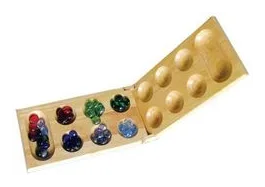
The most common rule set in games sold commercially as Mancala is for this game of Kalah. Mancala is actually a whole family of games. Kalah was invented in 1940 by an American, William Champion Jr.. He started selling the game in 1944, patented the rules in the 1950's, and founded the Kalah Game Co. in 1958. The game is played on a board of two rows, each consisting of six round pits. The rows have a large store at either end called the Kalah. A player owns the six pits closest to them and the Kalah on their right side. The game is started with four (4) seeds in each pit. A player takes all the seeds from one of their pits, and then they are distributed one by one, counterclockwise, in the pits and the player's own Kalah, but not into the opponent's store (Kalah). If the last seed is dropped into an opponent's pit or a non-empty pit of the player, the move ends without anything being captured. If the last seed falls into the player's Kalah, they must move again. If the last seed is put into an empty pit owned by the player, they capture all contents of the opposite pit together with the capturing piece and puts them in their Kalah. If the opposite pit is empty, nothing is captured. A capture ends the move. The game ends when one player no longer has any seeds in any of their holes. The remaining pieces are captured by their adversary. The player who has captured the most pieces is declared the winner. Variants: Beginners may start with 3 seeds in each pit, but the game can also be played with 5 or 6 seeds in each pit. William Champion Jr. recommended the expert game with 6 in each pit.