Overview
At a glance
Is this game right for my group?
ABG editorial scores on a 1–5 scale.
Harder to teach
High replayability
Highly interactive
Scales well
Deep strategy
How it plays
How does it play?
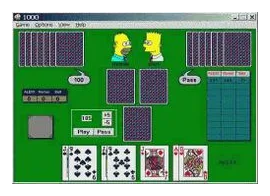
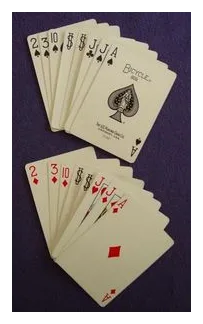
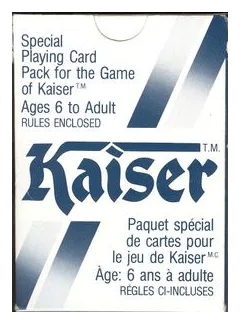
Kaiser is a Canadian trick-taking card game for four played in partnerships. The game uses a 32-card French-suited deck with a tweaked distribution: AKQJT98 in all suits, plus 7?, 7?, 5?, and 3?.
Core mechanisms
Key systems that shape the decisions players make.
Read the full game description
Kaiser is a Canadian trick-taking card game for four played in partnerships. The game uses a 32-card French-suited deck with a tweaked distribution: AKQJT98 in all suits, plus 7?, 7?, 5?, and 3?. Bids are made for how many tricks will be taken, and the winner names the trump suit. Points are added or subtracted depending on whether the bid is made. Each trick is worth a point. Winning the 5? or 3? is worth +5 or -3, respectively. The game has been around for at least 40 years and it is often believed that it has its origins in the Ukrainian culture, possibly being brought over by immigrants to Canada. The Pagat database and newer research indicate that it was introduced in the 1920s or 1930s and is a version of the traditional card-games Three-spot and Troika, but was re-named with the influence of the card game Joffre that was originally called "Shoo le Kaiser". Re-implementation of: Joffre Lost Heir (Kaiser has absolutely no connection with the ancient Swiss card game called Kaiserspiel or Kaiserjass.)