Overview
At a glance
Is this game right for my group?
ABG editorial scores on a 1–5 scale.
Harder to teach
High replayability
Highly interactive
Scales well
Deep strategy
How it plays
How does it play?
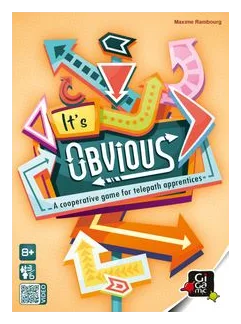
It's Obvious is a game in which you and your fellow players, as apprentices of telepathy, have to co-operatively — and secretly — select different image cards from the center of the table.
Core mechanisms
Key systems that shape the decisions players make.
Communication Limits
Rules restrict what players may say, show, or reveal while cooperating.
Cooperative Game
Players coordinate their actions toward a shared objective and win or lose together.
Deduction
Combine clues and exclusions to identify hidden information.
Connections
Create meaningful links between locations, pieces, or concepts.
Read the full game description
It's Obvious is a game in which you and your fellow players, as apprentices of telepathy, have to co-operatively — and secretly — select different image cards from the center of the table. In more detail, you choose an image card on display that in some way has a connection to the two image cards in front of you, stating something like "My choice is obvious!" or "It's a bit of stretch" or "I'm going for the non-obvious card as I think someone else will pick it". You may not give specific clues about what you have chosen or how it relates to one or both of the image cards in front of you; only a vague sense of how the choice feels to you. One more image card is on display than the number of players, and once you've chosen your target image, you indicate this choice on a numbered secret dial. Once all players have chosen, they reveal their choices. If you're the only one who picked an image, then you take that image card and cover one of the two images in front of you. If everyone chose different cards, then you win the round! If, however, not everyone chose different cards, then you lose the round and everyone who chose "incorrectly" draws a new image card at random from the deck to replace one of theirs. Sweep any remaining image cards from the center, then reveal the appropriate number of image cards to start a new round. If you lose a round for the third time, you lose the game; if you manage to complete a number of rounds (7-10) based on the player count before this happens, then you win! You can adjust the difficulty of the game in several ways to make it more or less difficult.