Overview
At a glance
Is this game right for my group?
ABG editorial scores on a 1–5 scale.
Harder to teach
High replayability
Highly interactive
Scales well
Deep strategy
How it plays
How does it play?
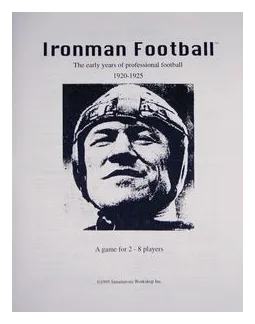
Ironman Football is a team management game based on gridiron football in the early 1920's.
Core mechanisms
Key systems that shape the decisions players make.
Read the full game description
Ironman Football is a team management game based on gridiron football in the early 1920's. That was a time when there were no TV million$, no real passing game as they played with a squashed medicine ball, shoulder padding was a sturdy arrant jumper, helmets were strictly optional and you were expected to play on both offense and defense. The game features such notable institutions as the Pottsville Maroons, the Dayton Triangles and the Frankford Yellowjackets, and mega stars like Red Grange, George Halas, Jim Thorpe and Paul Robeson. The game works on the old system of pulling a team together, playing a series of games, whacking down some event cards and trying to obtain the best record to win the league. At the start of the game you are handed some event cards, a league franchise, a team name and, unless you are very unlucky, a handful of star players. You also get some money. Your core players, the poor faceless grunts in the trenches, are abstracted into a simple team rating and a total salary bill (excellent idea) but the star players, the backs and ends, are each given their own individual card. As team manager, it is your job to balance the huge benefits of having these talented individuals on your staff with the interestingly high salaries they demand for performance. The three key areas of offense, defense and special teams can all be enhanced by the star cards. In addition to the player-controlled teams, who will usually play each other twice, the game also supplies a range of 'autopilot' opponents. There are league teams who are often as good, or even better, than the players' lineups and also sandlot teams. Event cards add a lot to almost any the game. They can be played either before your weekly scheduled game or during the game itself. Their effects are wide ranging; from new gadget plays that can give you an extra dice on offense, to sponsorship deals that enable you to sell out to local government for big money. There are college players, fan loyalty, rain insurance, scams, scandals, intrigue and even subtle stuff like players' agents, loyalty and defections. Once you have played the game, you work out the gate receipts, which are divided between the home team and the visitors based on a pre-agreed percentage split. There are variables such as number of star players on show, rain, home opener, whether you are playing a winning team, etc. As it is more profitable to be at home (no travel expenses) and to play the winning teams with the most star players, each team has an inherent draw factor - remember this is pre-TV - and can negotiate and earn high income accordingly. Want to play the top rated Canton Bulldogs (8-0-2, three star players) at home? You are going to have to offer their boss a healthy enticement to come to Oolong and perform against your 0-5 Indians, just to earn some money to pay off your overdraft. At the end of the game, having pocketed your share of the take, you must pay all the players their salaries and if you can't meet the payroll, you will start to lose staff. They may stay on out of the goodness of their hearts, but you also need to apply to the league for a stay of financial execution and avoid bankruptcy. All this links into the league structure. If you have any sort of claim against your opponent you may appeal and have your rival reprimanded or fined, and always at the back of your mind is simply surviving game to game. You must maintain a winning record, you need to find new players to satisfy the butcher's bill of game injuries and, if you survive all that and play nine games well, you'll get a shot at the league title. Interestingly, the game can be won by other means than just having the best record. The team with the most money also gets a point, and a winning season will accrue another. It is unlikely that with a title win you'll lose, but there will be teams close on your tail.