Overview
At a glance
Is this game right for my group?
ABG editorial scores on a 1–5 scale.
Harder to teach
High replayability
Highly interactive
Scales well
Deep strategy
How it plays
How does it play?
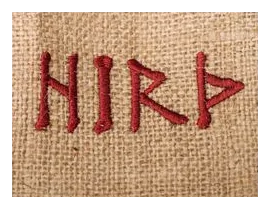
HIRÞ (pronounced hirth) is a two-player abstract strategy game in which two leaders (Viking kings) fight over control of a piece of land. The first to either control the five middle spaces or push the other player's king off the board wins.
Core mechanisms
Key systems that shape the decisions players make.
Area Majority
Compete to have the strongest presence in areas that award control or points.
Grid Movement
Move pieces between adjacent spaces on a regular grid.
Network and Route Building
Create connected routes that improve reach, delivery, control, or scoring.
Static Capture
Capture opposing pieces through fixed positional relationships.
Read the full game description
HIRÞ (pronounced hirth) is a two-player abstract strategy game in which two leaders (Viking kings) fight over control of a piece of land. The first to either control the five middle spaces or push the other player's king off the board wins. Although it has a relatively small board (eleven squares), the ability to use moves to build stronger units makes the gameplay quite intricate. The game is designed in recent times but with the ambition of resembling a game that could potentially have been found in a Viking grave. In the game, the players start on each short end of the board and take turns. Each turn they can make five moves. For a move, a player either moves one piece (Hird or King) one step, moves a Hird into or off a Karve (boat), or moves a Karve and all Hirds on it one step. A Karve may have at most four Hirds on it. Pieces entering empty spaces have to stop. Pieces entering enemy-controlled spaces stop on the line between the spaces. After a player's five moves, any conflicts (pieces on lines) are resolved. All pieces except empty Karve are worth 1. The King is tiebreaker. In case of a loss, solitary Hirds are removed from the game, Karves and Hirds in Karves are removed from play, and Kings have to retreat to an adjacent empty or friendly space. If there are no possible squares for the King to move to, the player loses. If after their turn a player controls all five middle spaces, that player wins. There is also a doubling coin in the game affecting points received if several games are played. Normally a game is won after receiving five points.