Overview
At a glance
Is this game right for my group?
ABG editorial scores on a 1–5 scale.
Harder to teach
High replayability
Low interaction
Scales well
Deep strategy
How it plays
How does it play?
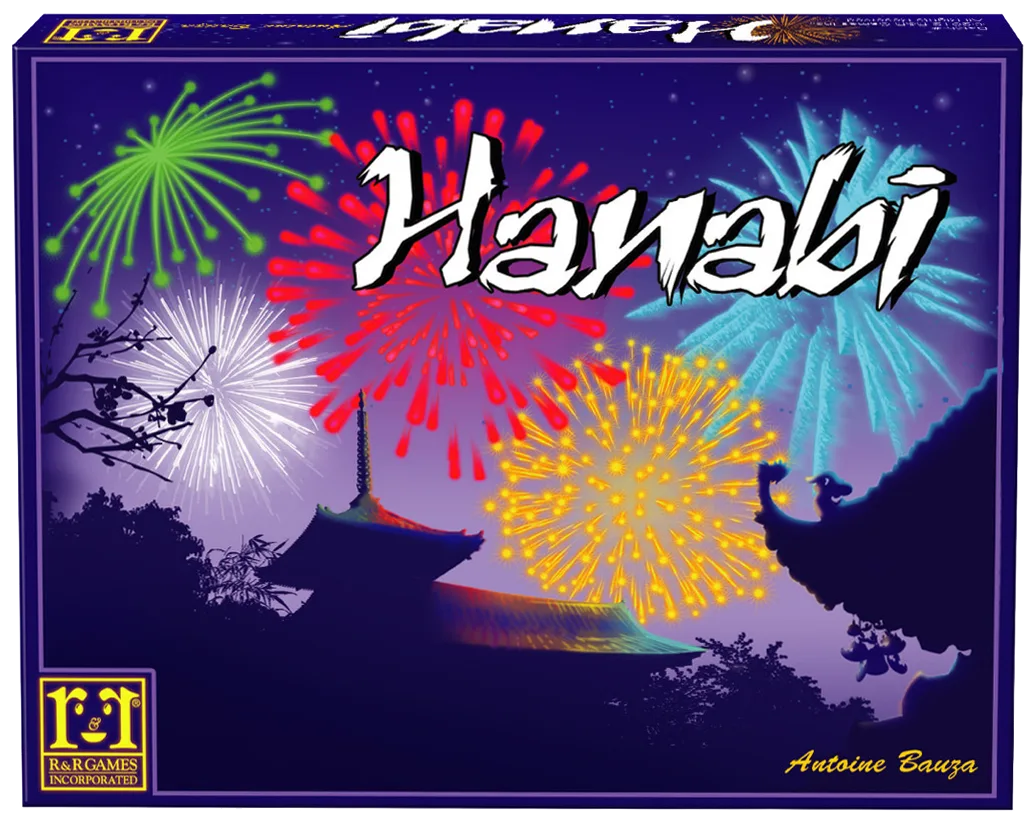
Hanabi—named for the Japanese word for "fireworks"—is a cooperative game in which players try to create the perfect fireworks show by placing the cards on the table in the right order. (In Japanese, hanabi is written as ??; these are the ideograms flower and fire, respectively.)
Core mechanisms
Key systems that shape the decisions players make.
Set Collection
Gather related items that become more valuable when scored together.
Communication Limits
Rules restrict what players may say, show, or reveal while cooperating.
Cooperative Game
Players coordinate their actions toward a shared objective and win or lose together.
Hand Management
Time and sequence a limited hand of cards to preserve future options.
Memory
Remember previously revealed information, positions, or sequences.
Read the full game description
Hanabi—named for the Japanese word for "fireworks"—is a cooperative game in which players try to create the perfect fireworks show by placing the cards on the table in the right order. (In Japanese, hanabi is written as ??; these are the ideograms flower and fire, respectively.) The card deck consists of five different colors of cards, numbered 1–5 in each color. For each color, the players try to place a row in the correct order from 1–5. Sounds easy, right? Well, not quite, as in this game you hold your cards so that they're visible only to other players. To assist other players in playing a card, you must give them hints regarding the numbers or the colors of their cards. Players must act as a team to avoid errors and to finish the fireworks display before they run out of cards. An extra suit of cards, rainbow colored, is also provided for advanced or variant play. Hanabi was originally published as part of Hanabi & Ikebana.