Overview
At a glance
Is this game right for my group?
ABG editorial scores on a 1–5 scale.
Harder to teach
High replayability
Highly interactive
Scales well
Deep strategy
How it plays
How does it play?
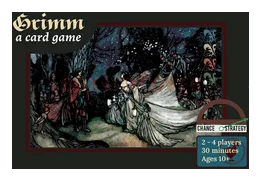
Grimm is a 60 card game that is can be played with two (2) to four (4) players. The gameplay is fully strategy-driven, utilizing psychology, trick-taking, and game theory.
Core mechanisms
Key systems that shape the decisions players make.
Read the full game description
Grimm is a 60 card game that is can be played with two (2) to four (4) players. The gameplay is fully strategy-driven, utilizing psychology, trick-taking, and game theory. It is based on the Grimm Fairy Tales and the artwork of Arthur Rackham. The game has two types of cards, Prize Cards and Bidding Cards. Both the Prize Cards and Bidding Cards have powers and combinations that cause players to rework and execute evolving strategies throughout the game. The Prize Cards are captured in a series of four bidding rounds and have different values (Victory Points) which are triggered by the types of cards each player captures. A summary of their follows are as follows: A Prince and A Princess are worth (0) alone and (12) a piece when paired, The Angel Mother can turn the Maiden card into a princess, The Maiden has a value of nine (9) on her own, The Witch is worth negative thirteen (-13) alone and positive thirteen (+13) if combined with both Hansel and Gretel, Gold cards are worth one (1) on their own and are worth two (2) when collected with the Dragon, Rumpelstiltskin can also turn any card into a Gold card, and Dwarf cards increase exponentially when the player collects more Dwarf cards. One card is worth one (1) point to the player, two cards are worth four (4) points to the player, up to seven cards are worth forty-nine (49) points to the player. The Bidding Cards are from 0 - 7 and are used to capture the Prize Cards. The bidding tactics each player employs are based on how others bid and capture cards, a player's individual Prize Card strategy, and each player's reading of their opponents. A few Bidding Cards have special rules: 0/8 Dove—usually acts a zero (0), the lowest bidding card, but when a step-sister card is played—it becomes an eight (8), the highest card. 1 Goose—when three or four players are playing, if two (2) goose cards are played, the fox card becomes worth zero (0). 3 Cat & Mouse—can only be used once per game (rather than once per round as the others). This card is bid face up and then the Cat & Mouse bidder(s) bids one more card face down before the other bidding cards are turned face up. —description from the publisher